SECUREBOX
SecureBox Pty Ltd • Proposed business plan

SecureBox

Secure deliveries. Complete peace of mind.
SecureBox app splash screen
Connected
SecureBox tall unit with keypad, QR scanner and camera
Scroll to explore

Explore the plan

Six sections. One complete business proposal.
SecureBox unit, closed
Access approved
Locked
{{ p.num }}
{{ p.label }} {{ p.desc }}
{{ p.cta }}
01 / 06
Scroll to open the plan
01Business overview video
45 second supplementary business overviewFormal stakeholder pitch → Section 05

SecureBox is a smart parcel-security system addressing the gap between courier drop-off and customer collection. Its value proposition combines secure at-home storage, controlled courier access and real-time monitoring, creating a direct-sale business model designed around safer and more accountable unattended delivery.

01The problem

The courier has left.
The parcel hasn’t reached you.

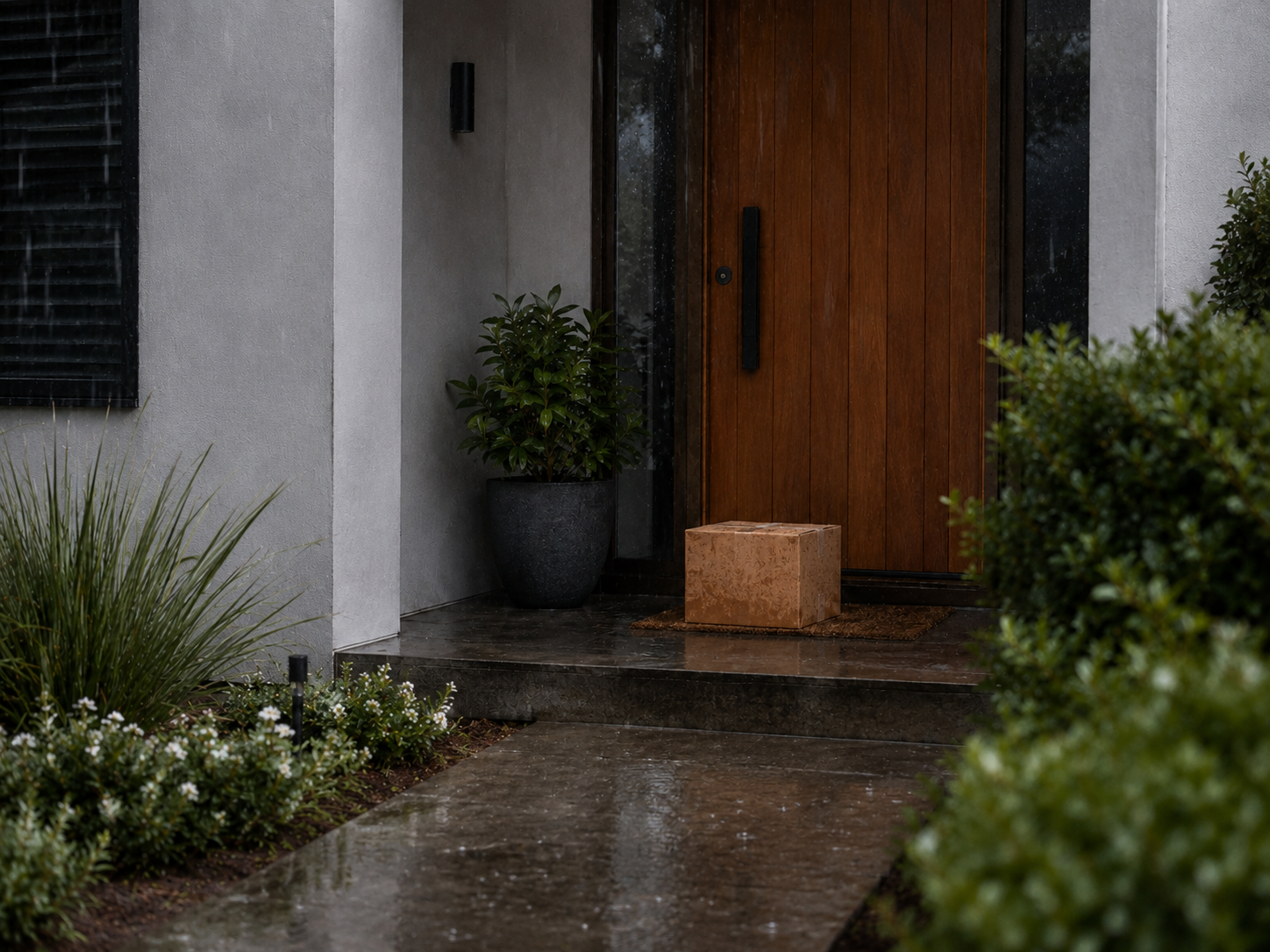
When a customer is away during delivery hours, a parcel can sit outside the home between courier drop-off and customer collection: visible, accessible and outside the customer’s control.
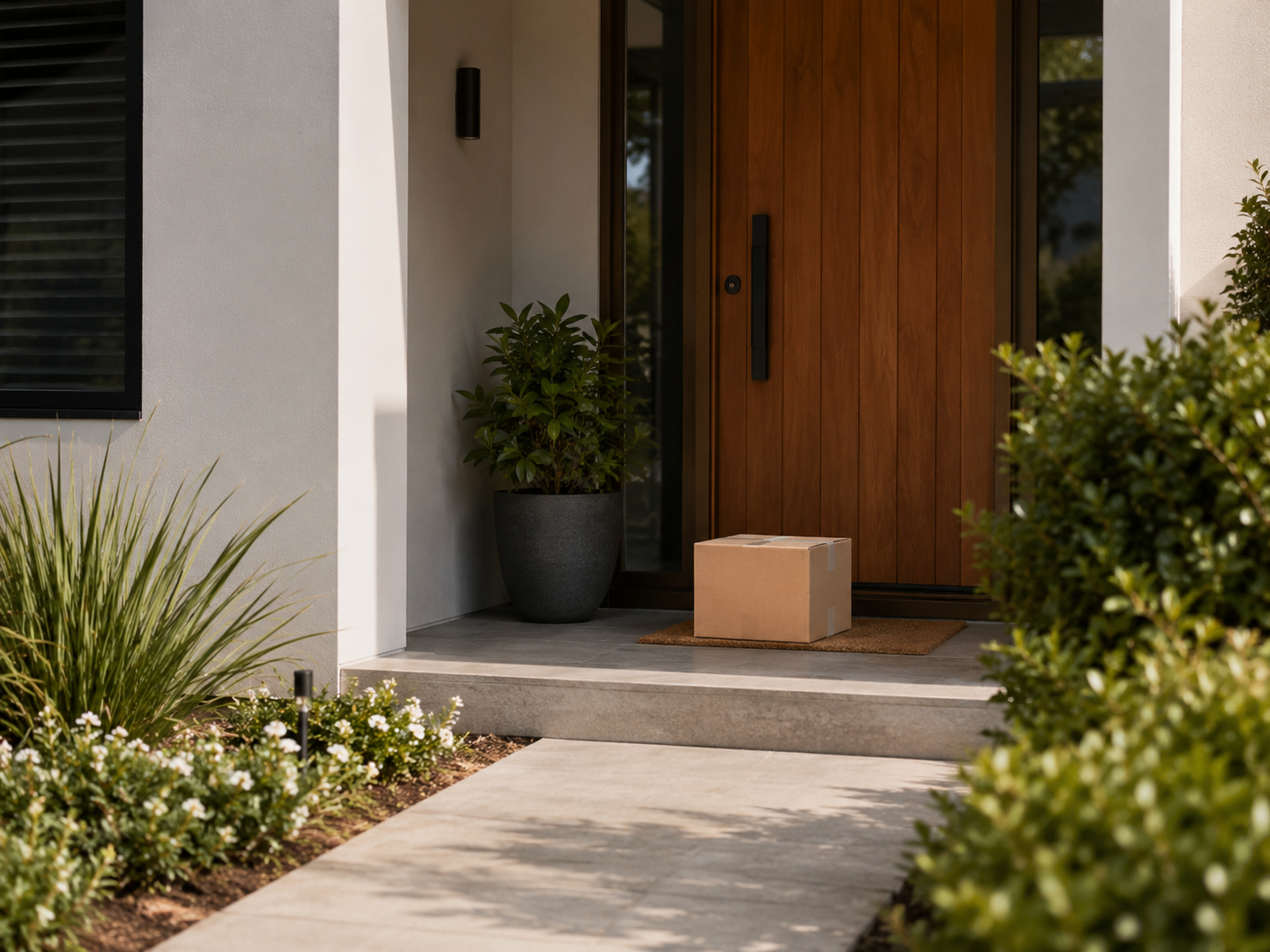
Parcel left beside the front door of an Australian home while nobody is home
80%+of surveyed respondents are normally away during delivery hours.
SecureBox primary research survey, n = 36, 2026.
Parcel left alone beside a front door after the courier has gone
01

Unattended after drop-off

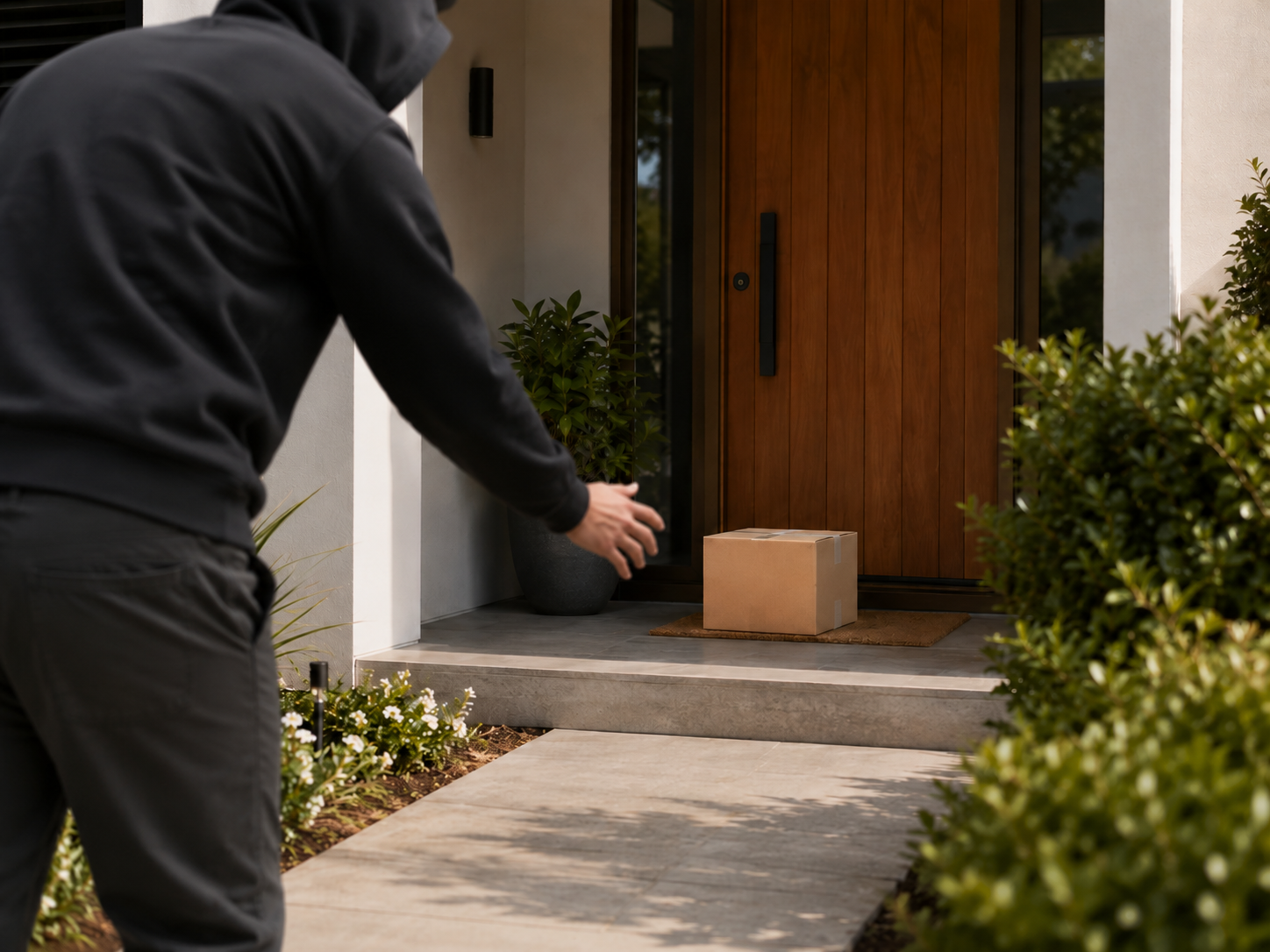
Unknown person reaching for a parcel at a front door
02

Visible. Accessible. Outside the customer’s control.
61% of SecureBox survey respondents are concerned about parcel theft.
SecureBox primary research survey, n = 36, 2026.
Parcel exposed to rain on a wet front porch
03

Exposed and unverified

Even when nothing is stolen, the parcel can be exposed to weather or damage with little evidence of what happened after drop-off.

75% of respondents have experienced parcels being left unattended.
SecureBox primary research survey, n = 36, 2026.
Delivery complete≠parcel secure
03The solution

Meet SecureBox.

A secure handover point for the part of delivery that happens when nobody is home.
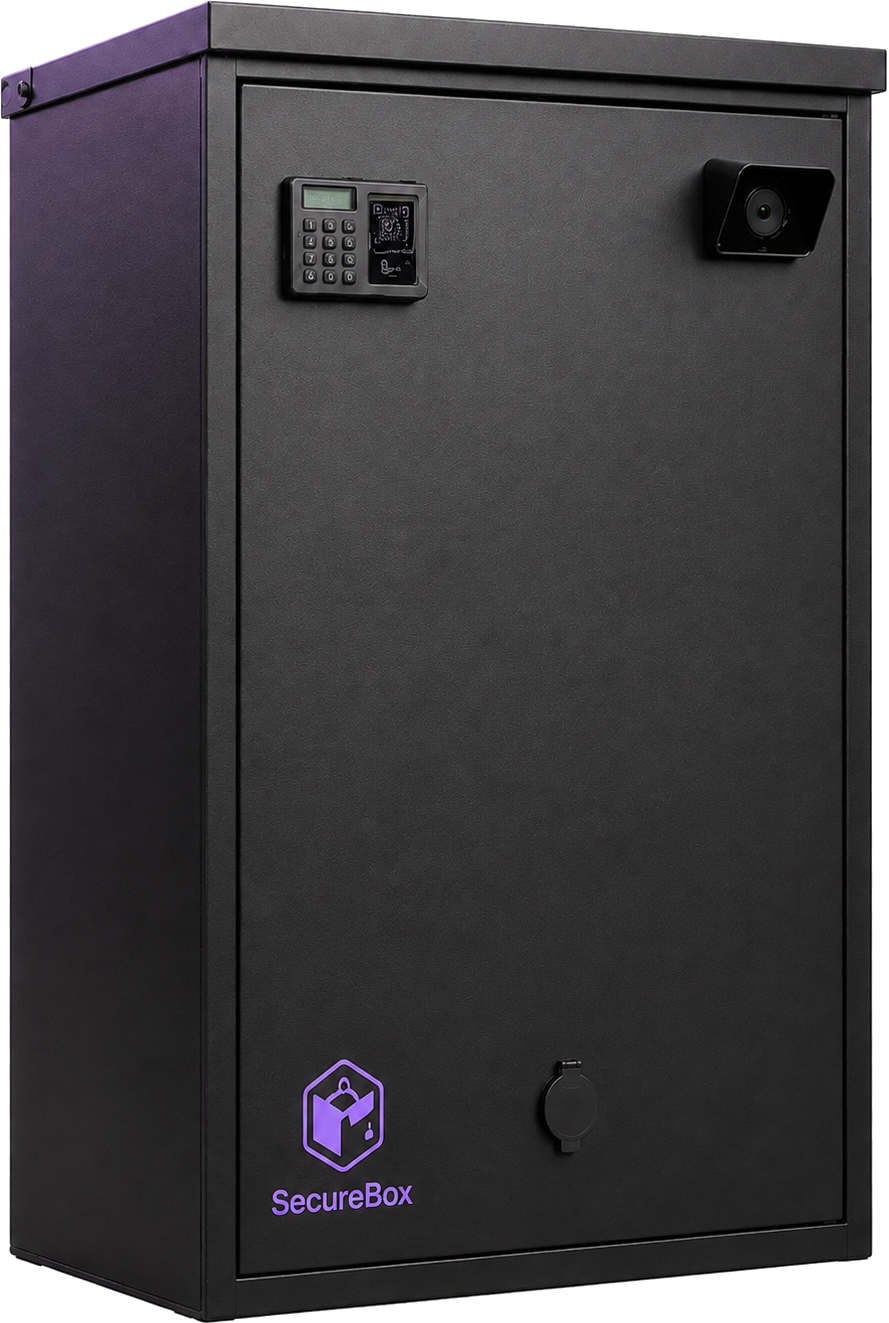
The complete SecureBox unit, showing the QR scanner, keypad, camera and backup key slot
The doorstep, controlled.
–

Three things SecureBox does.

01
Physical securityProtects the parcel.
02
Controlled accessLets the authorised courier deliver.
03
Customer visibilityConfirms what happened while the owner was away.
01
Physical security

The parcel is no longer left exposed.

Weather-resistant enclosureProtects the parcel from rain and weather.
Electronic lockRe-engages after the courier closes the lid.
Concealed anchoringInternal anchoring points make removing the whole enclosure difficult.
Door and tamper sensorsDetect closure and unexpected interference.
02
Controlled access

Delivery access without permanent access.

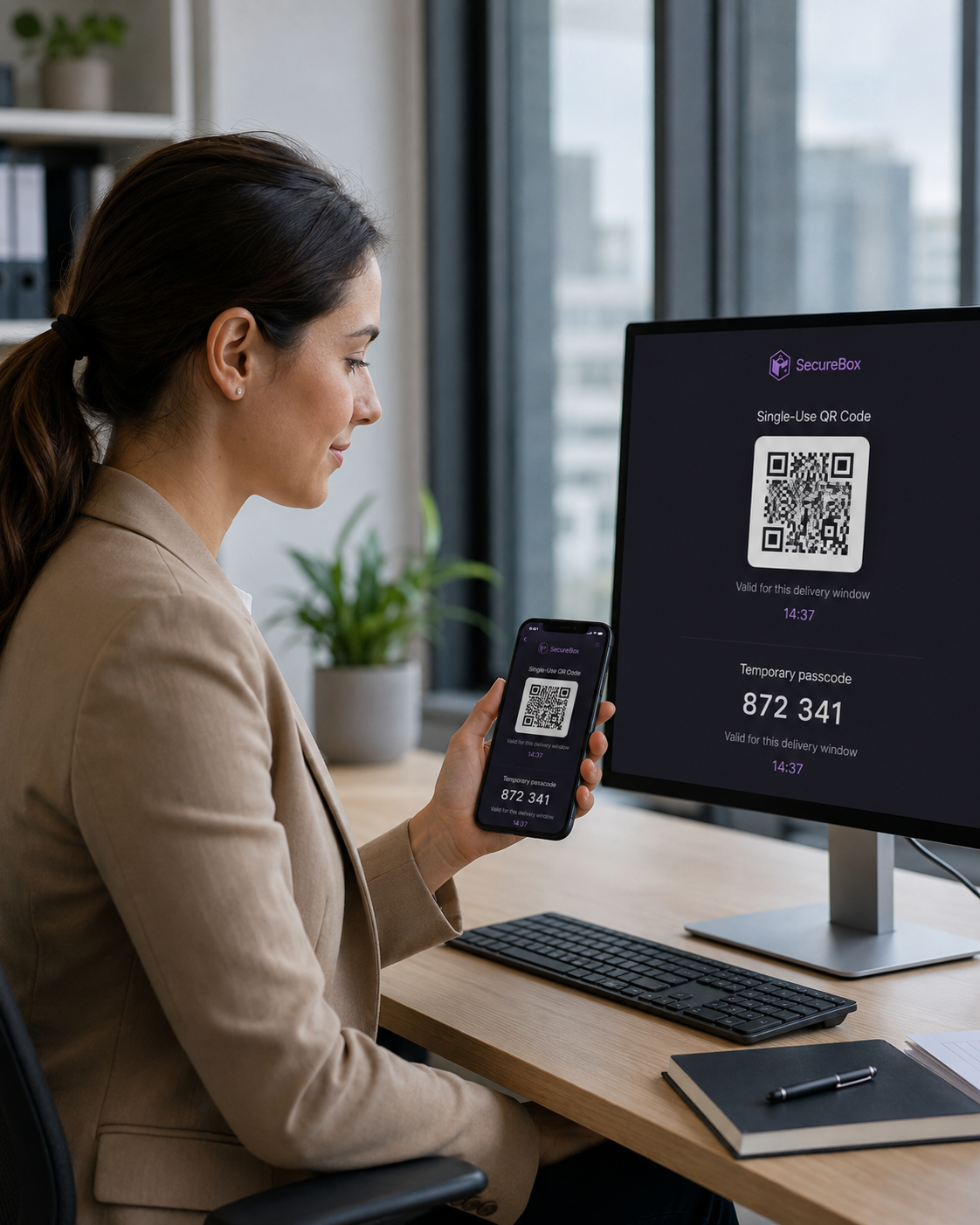
The owner creates a single-use QR code or temporary passcode. Once the authorised delivery is completed, that credential expires.

No courier account or SecureBox app required.
Live accessUsedExpired
03
Customer visibility

Know the parcel made it inside.

Confirmation arrives in the SecureBox app.
Camera event
Parcel secured
SecureBox locked
Activity logged
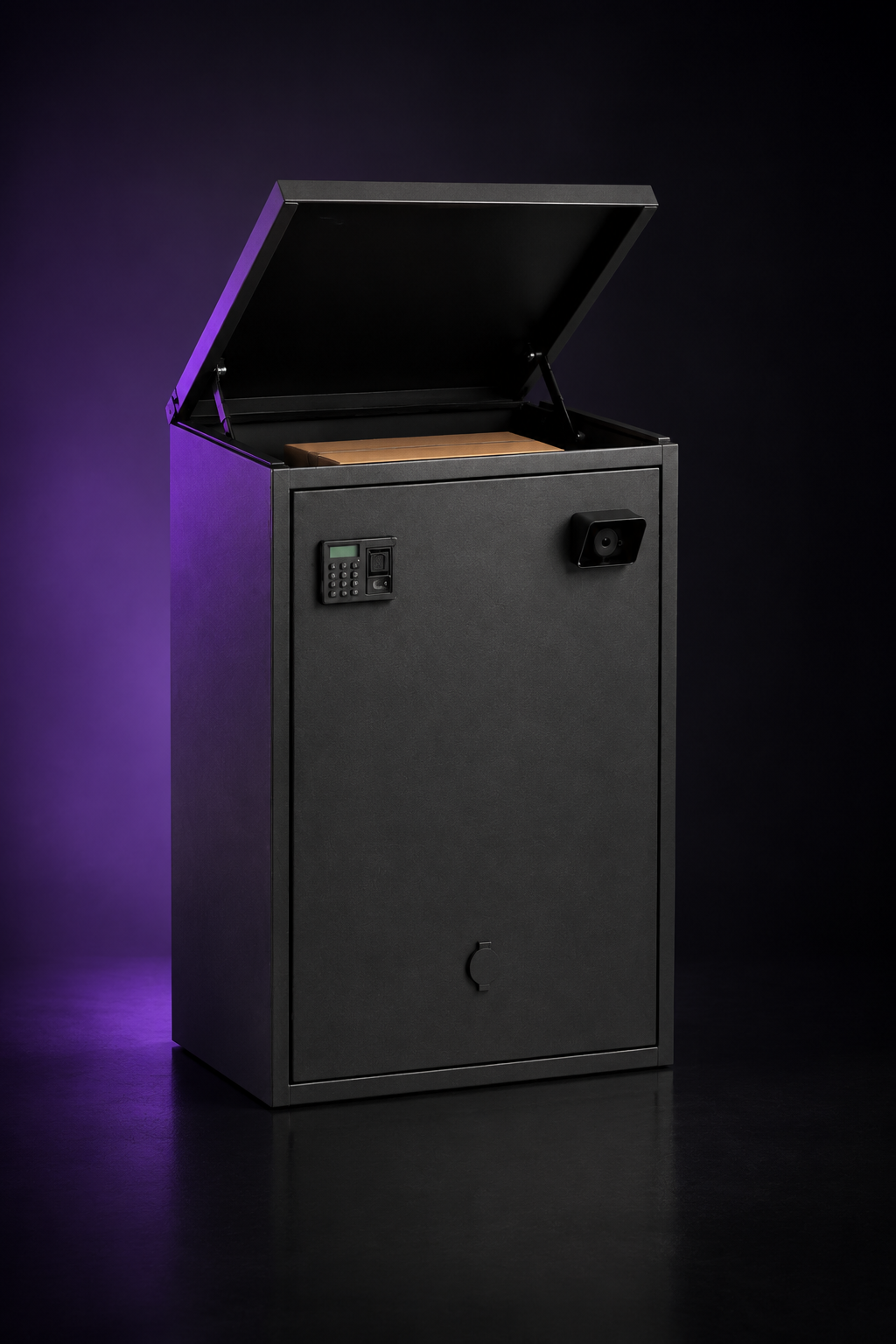
SecureBox with the lid open, showing the parcel, keypad, camera and backup key slot
01Physical security
02Controlled access
03Customer visibility
Electronic lock
Weather-resistant enclosure
Tamper sensor
Delivery accessLive
Single use04:59
Used, expired
Access approved
Activity log
10:42SecureBox opened
10:43Parcel secured
10:43SecureBox locked
Delivery verified
Camera monitoring
04 Interactive prototype

Control SecureBox while you’re away.

A simulated walkthrough of one delivery.

10:32SecureBox{{ app.battery }}
Front porch
Online
{{ app.statusTitle }}
{{ app.statusText }}
My SecureBox
SecureBox One
Lock{{ app.lockValue }}
Door{{ app.doorValue }}
Parcel{{ app.parcelValue }}
Seal{{ app.seal }}
Battery{{ app.battery }}
Live camera
{{ app.camPillLabel }}
Privacy mode on
Access
{{ app.codeKind }}
{{ app.codeValue }}
{{ app.codeStatus }}
No active courier access.
Activity
{{ ev.text }} {{ ev.time }}
Settings
{{ app.linkLabel }}
Try the interactive demo
Guided delivery, stage {{ app.demoNum }} of 6
{{ app.demoTitle }}
{{ app.demoText }}
{{ app.toastText }}
Courier access
Credential type
Expires in

SecureBox app

The app lets customers manage and verify a delivery from wherever they are.

05How SecureBox works

One delivery. Five steps.

SecureBox owner generating a single-use QR code and temporary passcode before a delivery
01

Owner prepares access

Owner creates a single-use QR code or temporary passcode for the delivery window.

Single-use QR · Temporary passcode · Delivery-window only
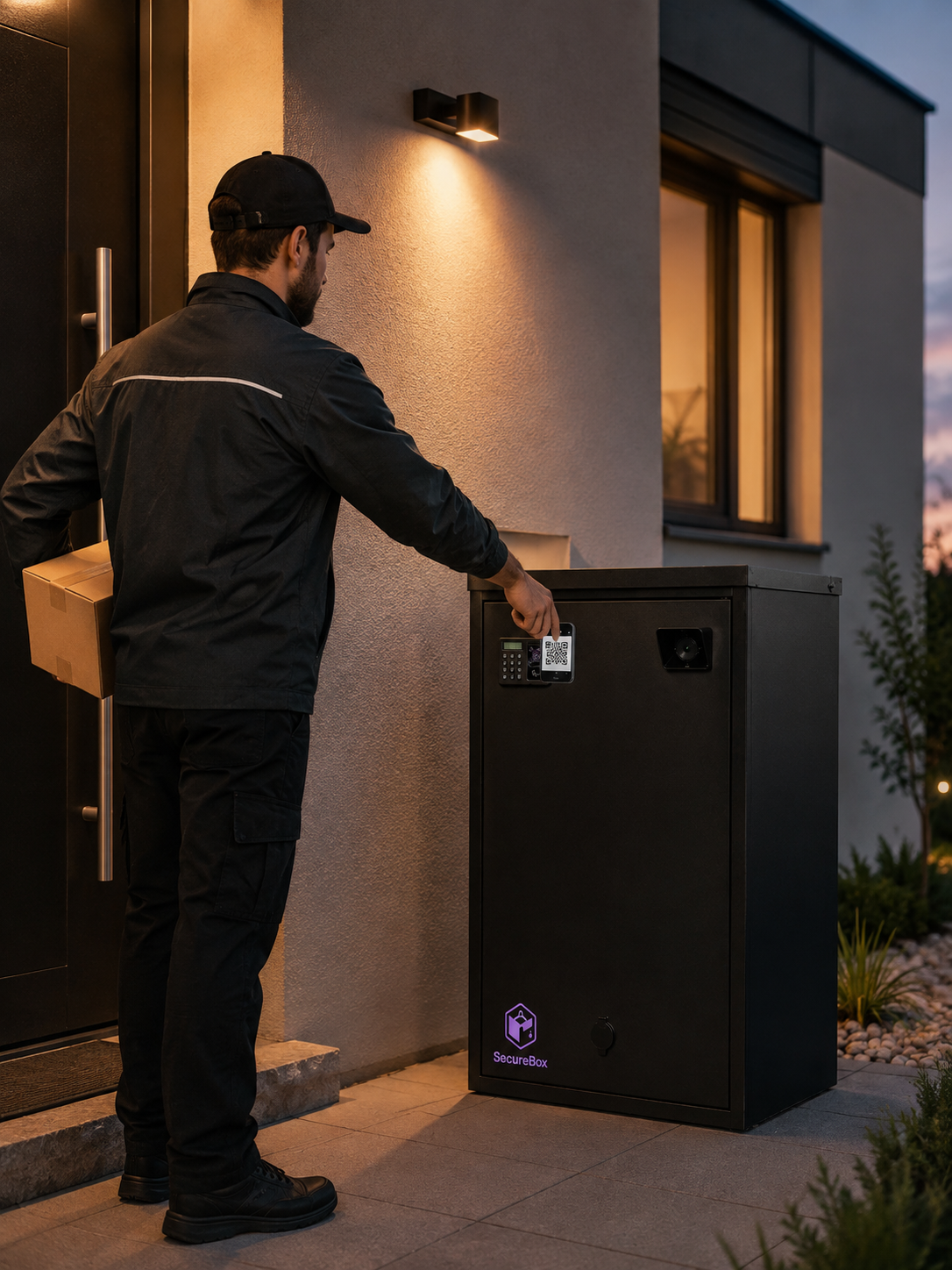
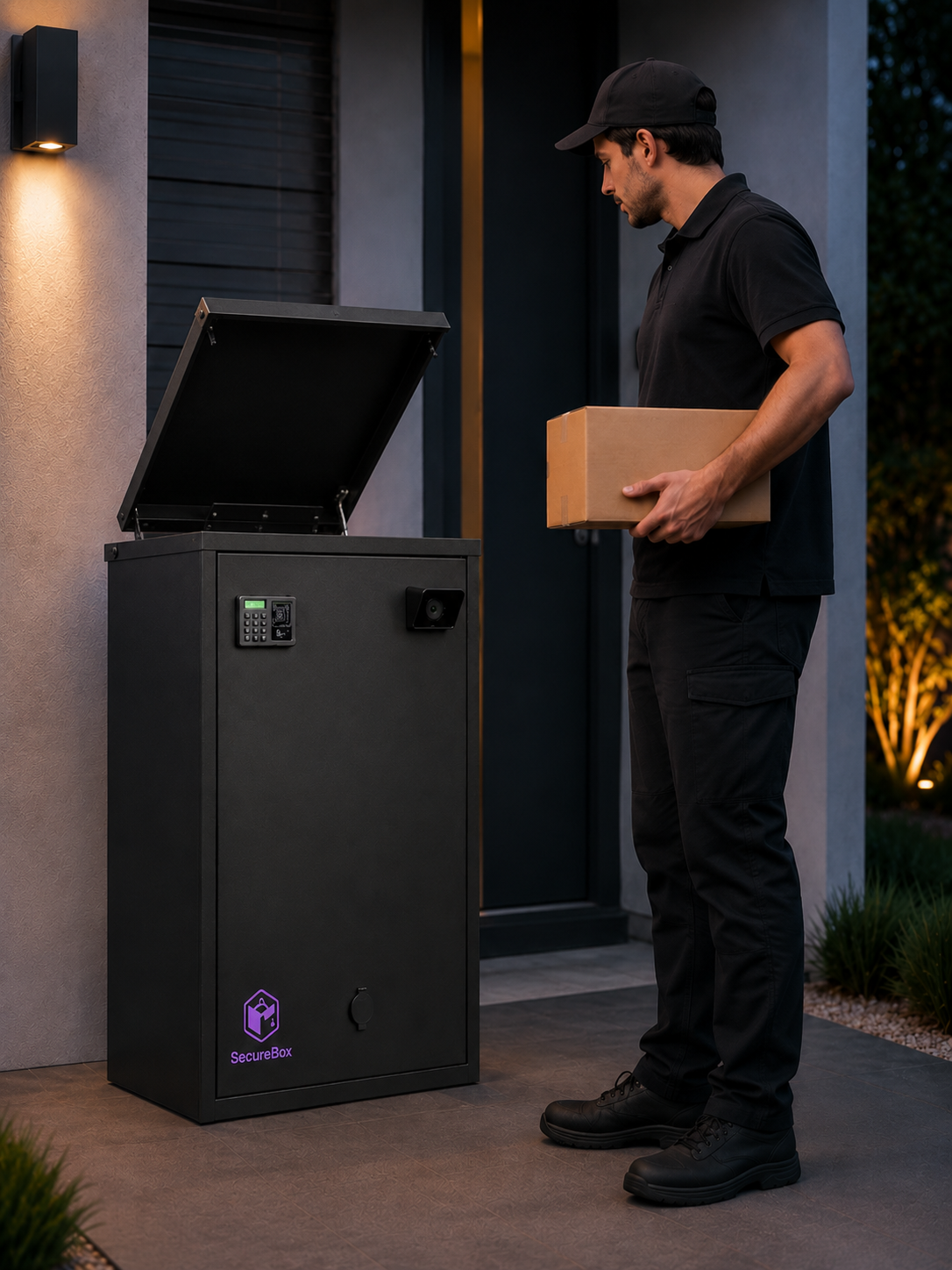
Courier holding a parcel while scanning the QR code at the SecureBox unit
02

Courier arrives

Courier scans the QR code or enters the backup passcode. No courier account is required.

QR scan · Backup passcode · No courier account
SecureBox lid releasing after the credential is verified
03

Access verified

SecureBox checks that the credential is valid, unused and within the delivery window, then releases the lock.

Credential checked → Access approved → Lock releases
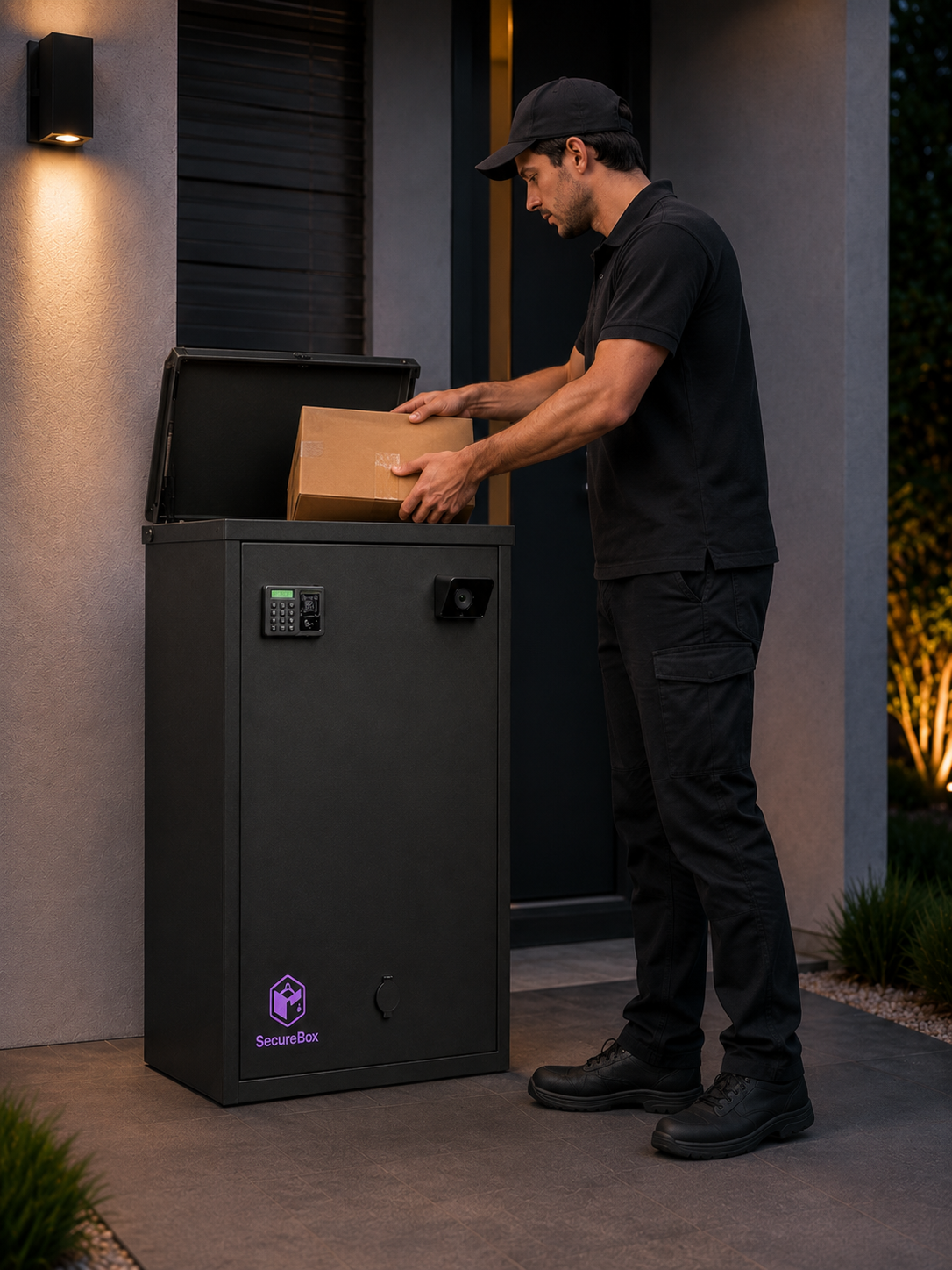
Courier lowering the parcel through the top opening of SecureBox
04

Parcel secured

Courier places the parcel inside. The lid closes, the lock re-engages and the credential expires.

Parcel deposited → Lid closes → Credential expires
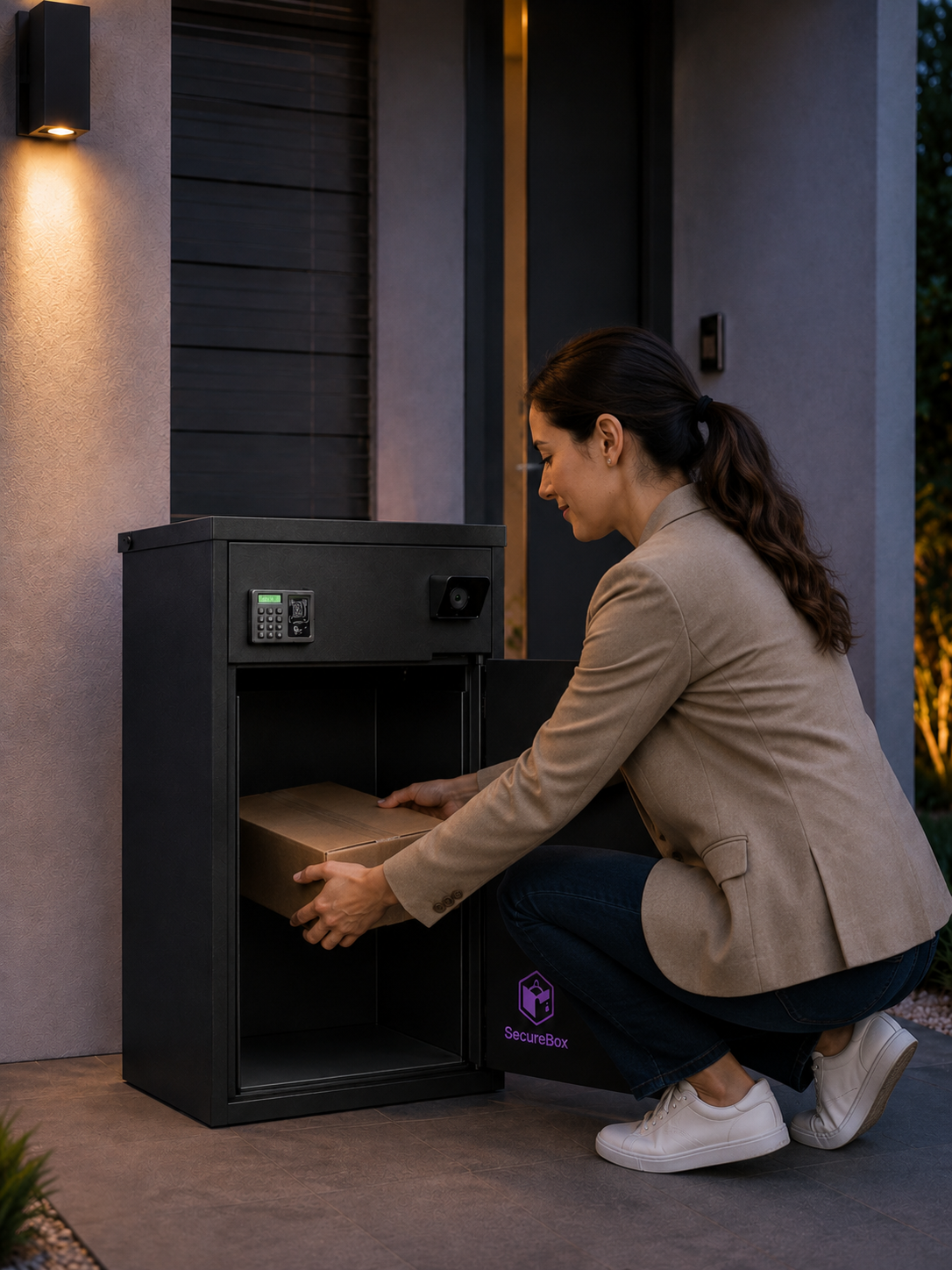
SecureBox owner collecting the parcel from the front door of the unit
05

Customer collects

The owner receives confirmation and retrieves the parcel securely when they return home.

Delivery confirmed · SecureBox locked · Parcel ready

Why the journey is designed this way

Survey evidence informed temporary courier access, single-use credentials, backup passcodes, automatic locking and instant confirmation, balancing security with courier usability.
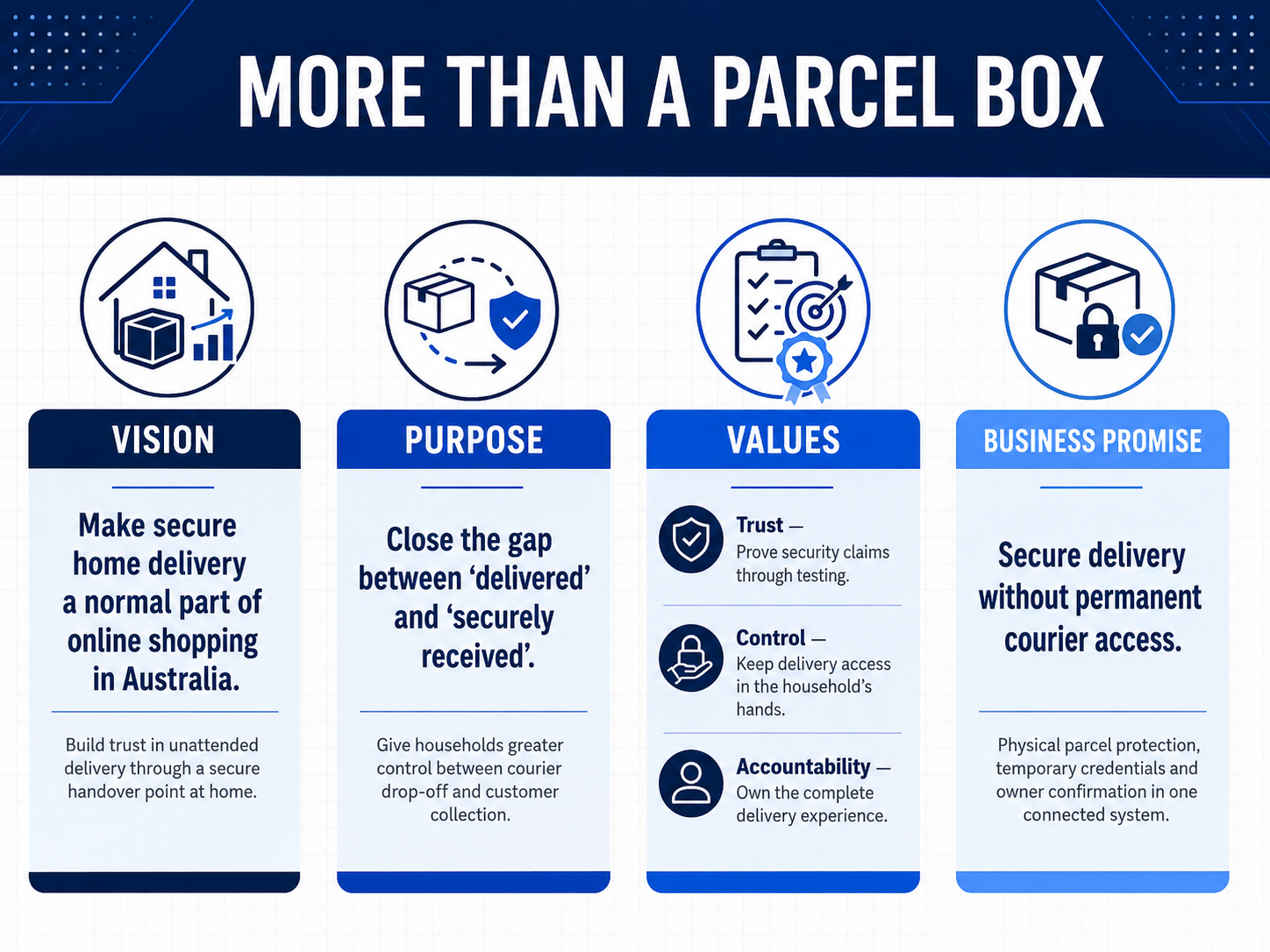
06Vision, purpose and values
More than a parcel box: SecureBox vision, purpose and values: trust, control and accountability

SecureBox’s vision, purpose and values centre on keeping delivery access under the household’s control, making unattended delivery safer and more accountable.

07Operations and distribution
Operations process
01Sourcing

Approved enclosure, lock, sensor, camera, control-board, battery and fixing components

02Adelaide assembly

Hardware integration and component installation

03Software pairing

SecureBox app, access-control system and device pairing

04Quality assurance

Lock, QR/passcode, tamper sensor, camera and weather-resistance checks

05Packing & dispatch

Controlled production batches prepared for customer delivery

06Customer setup & support

Installation guidance, app onboarding and after-sales support

SecureBox uses a controlled supply-chain and quality-assurance process, with imported components inspected before Adelaide assembly, software pairing and product testing. Local quality control reduces operational risk, improves consistency and allows faults to be identified before customer dispatch.

Locations and outlets

Adelaide first. National reach after validation.
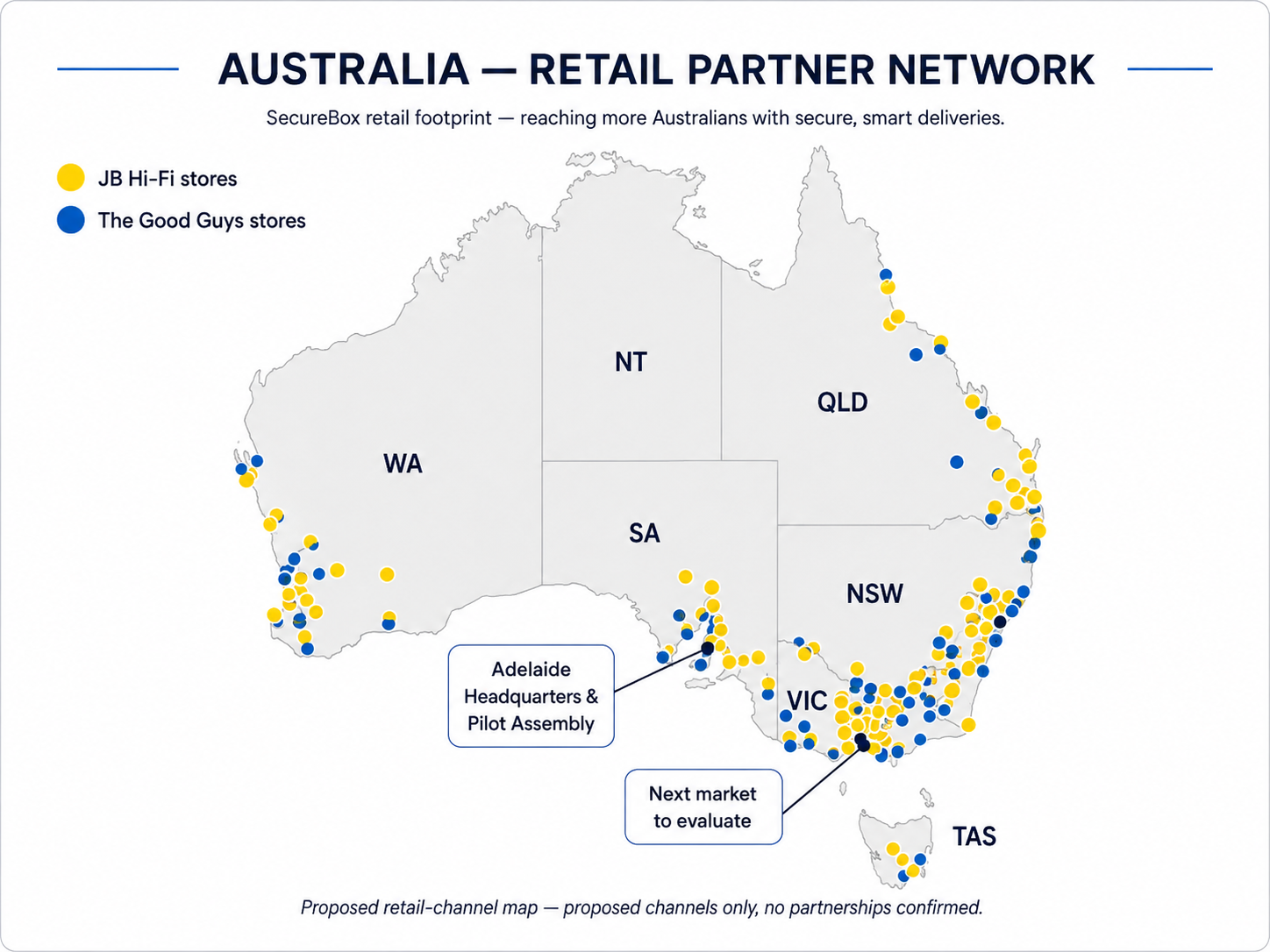
Map of Australia showing Adelaide headquarters and pilot assembly, proposed JB Hi-Fi and The Good Guys retail locations, and future interstate expansion
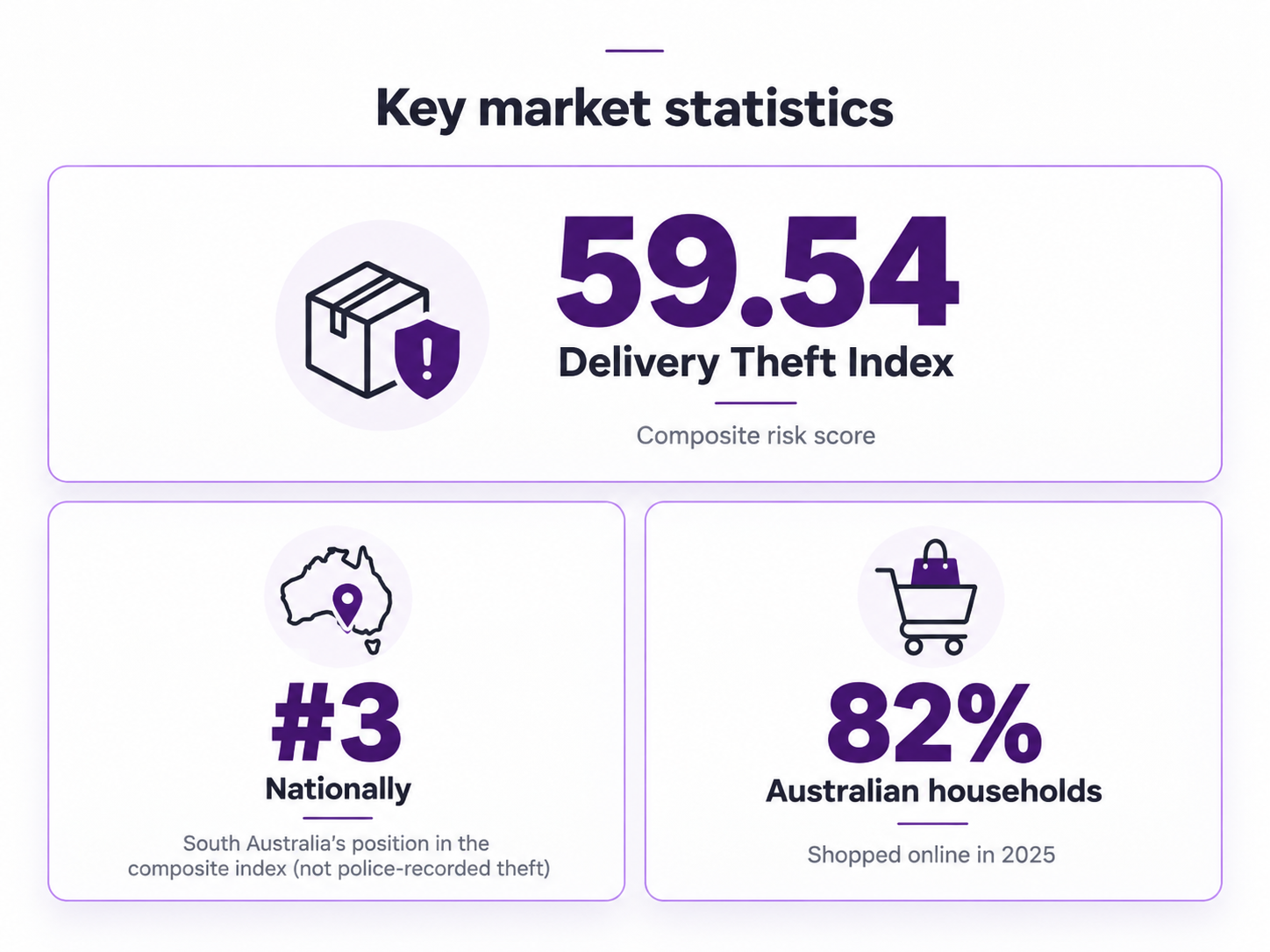
Key market statistics: Delivery Theft Index composite risk score of 59.54; South Australia ranked #3 nationally in the composite index (not police-recorded theft); 82% of Australian households shopped online in 2025

These indicators reinforce Adelaide as a strong pilot market, with high online-shopping participation and a meaningful parcel-security problem.

SecureBox will launch through direct online sales from Adelaide, allowing demand, courier usability and product reliability to be tested close to the initial customer problem. South Australia’s delivery-theft risk and strong online-shopping participation support Adelaide as a suitable pilot market. Proposed retail distribution would be considered only after evidence from the pilot supports wider commercialisation.

Adelaide
Validate
Retail trial
Scale
Proposed retail channels only, no partnerships confirmed.
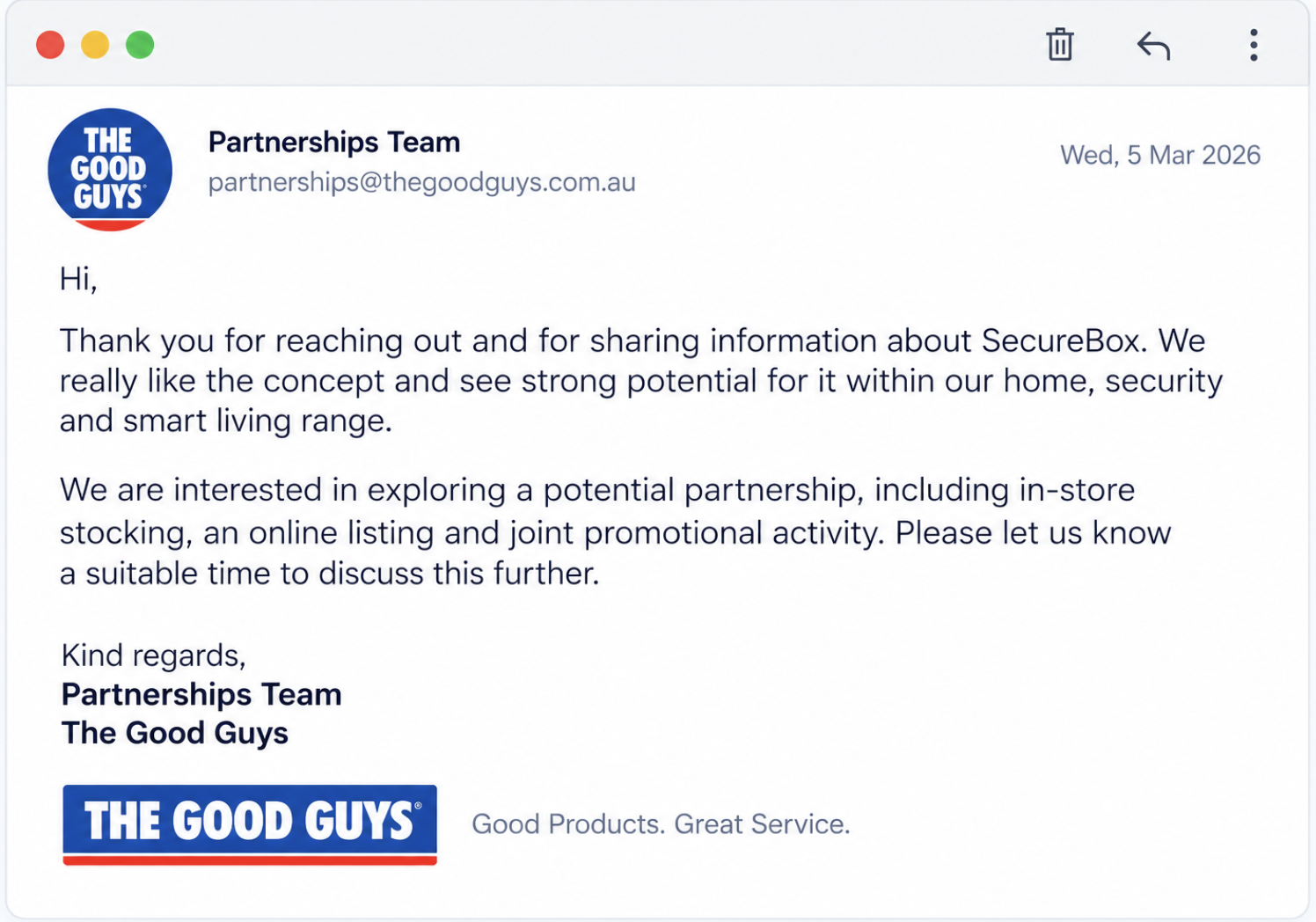
Simulated retailer channel planning communications

Simulated planning communications illustrating two potential retail pathways for SecureBox.
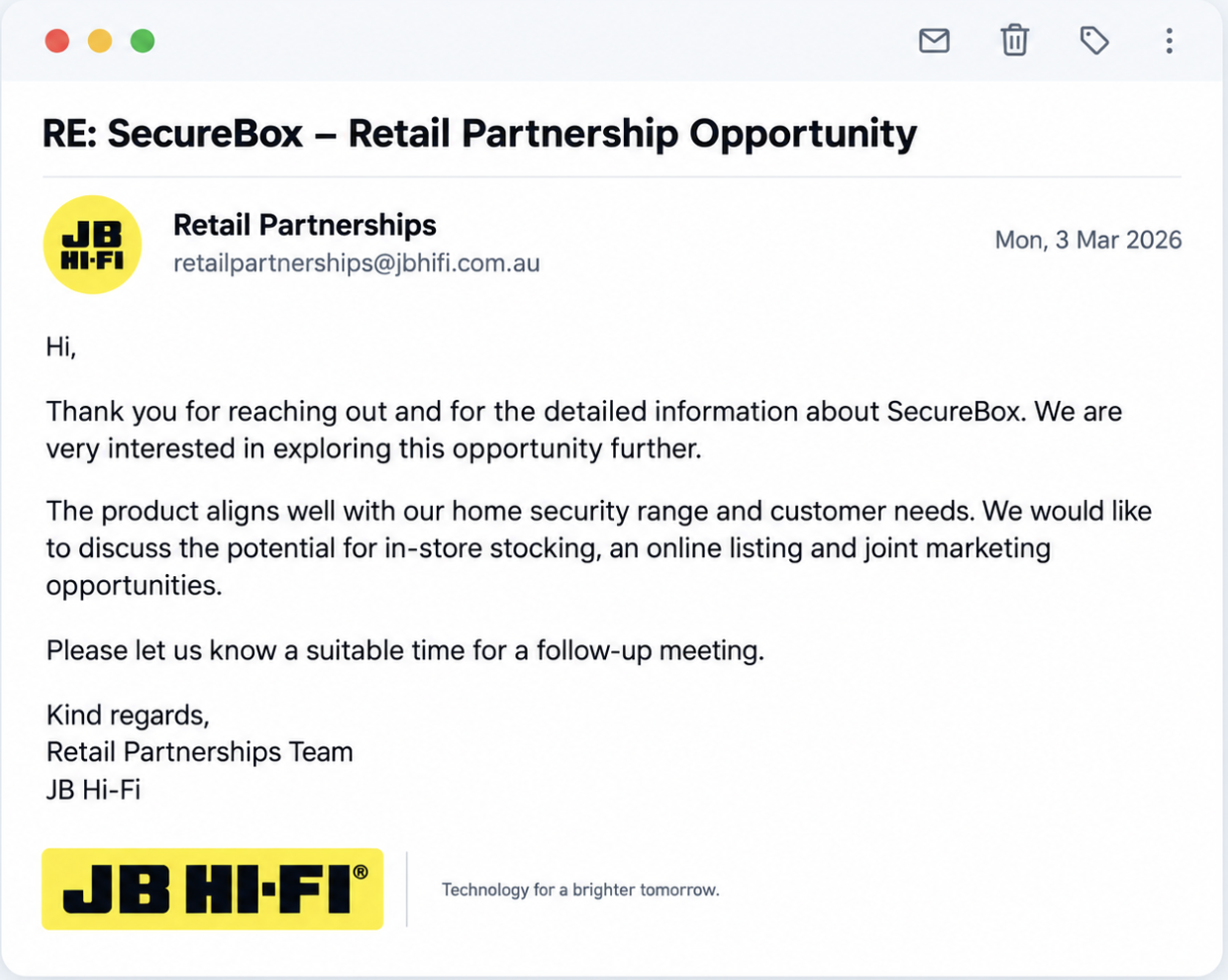
Simulated JB Hi-Fi retail-channel planning communication showing proposed in-store, online and promotional opportunities.
Simulated The Good Guys retail-channel planning communication showing proposed smart-home retail, online and promotional opportunities.

The simulated JB Hi-Fi and The Good Guys communications show two potential retail pathways for SecureBox. JB Hi-Fi could provide technology-focused in-store and online exposure, while The Good Guys could position SecureBox within the smart-home market. Both are proposed channels only and do not represent confirmed partnerships.
08Business structure

From sole trader to SecureBox Pty Ltd

Business intelligence and stakeholder evidence informed SecureBox’s proposed legal structure and ownership model.

Initial optionSole trader

Simpler and cheaper to establish, suiting a small early-stage business.

Stakeholder insightBusiness-owner interview

Highlighted separating personal liability from business risk as the business grows.

Secondary researchGovernment evidence

A sole trader is personally responsible for business debts; a company is a separate legal entity whose members generally receive limited liability.

Final decisionProposed SecureBox Pty Ltd

A proprietary company limited by shares, chosen for SecureBox’s product-liability exposure, supplier relationships, future investment and scalability.

Why a company structure fits SecureBox

01Limited liability

A separate legal entity better separates personal and business risk for a physical electronic product exposed to warranty and product-liability claims.

02Scalability

A proprietary company provides a stronger structure for supplier agreements, future investment and commercial growth.

03Governance

Greater compliance and administration are accepted in exchange for stronger risk management and long-term commercial credibility.

Proposed business registration

Legal structureProprietary company limited by shares
Proposed entitySecureBox Pty Ltd
Ownership modelFounder-operated at launch
StatusProposed, subject to formal registration before commercial launch
Registration pathwayASIC registration · ACN · ABN/company TFN · Director ID · GST registration where applicable

Organisational structure

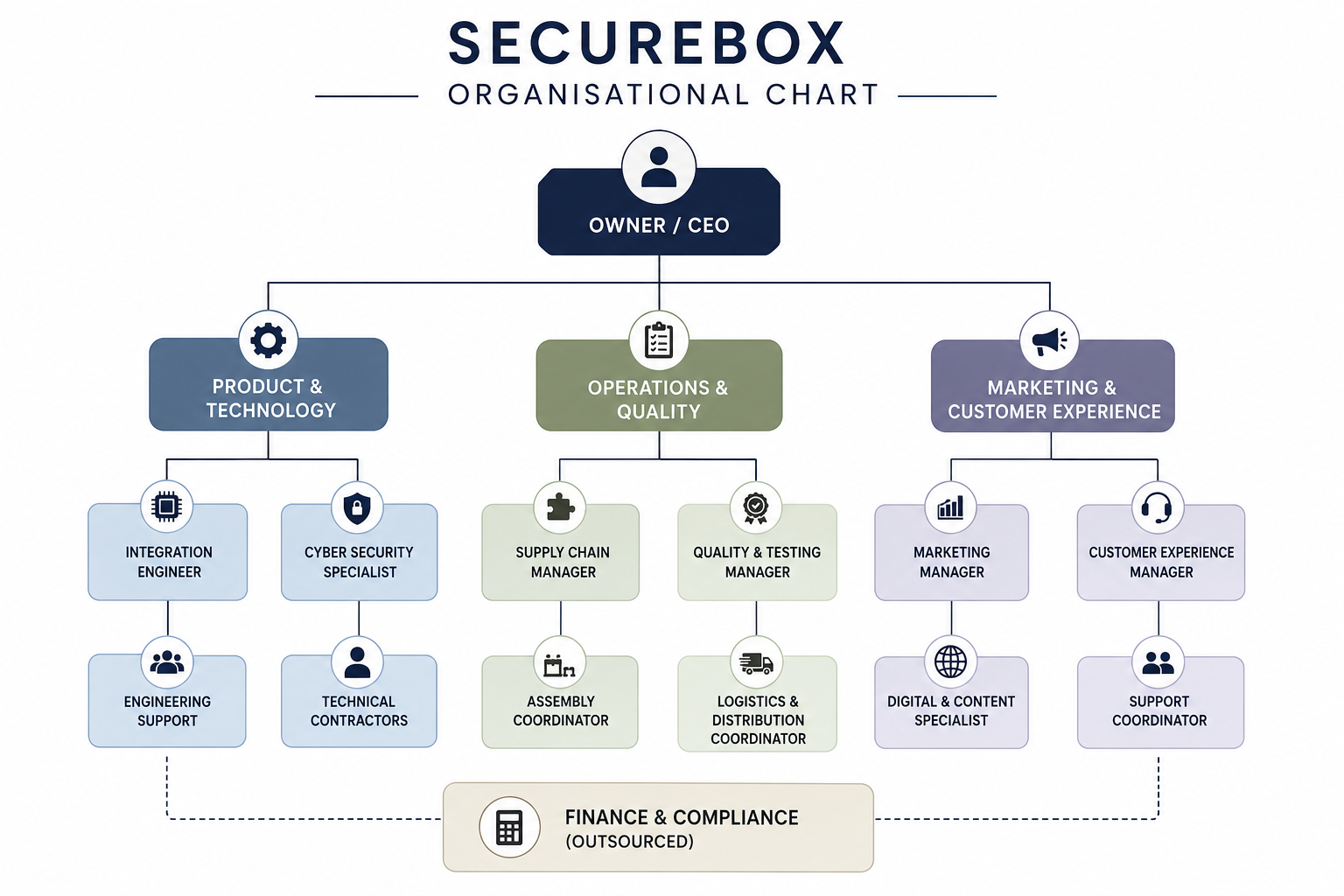
SecureBox organisational chart: Owner / CEO above Product and Technology, Operations and Quality, and Marketing and Customer Experience, with Finance and Compliance outsourced

SecureBox will initially operate with a lean structure, with core product, operations and marketing responsibilities managed internally while specialist finance, compliance and technical services are outsourced until sales justify additional employees.

Legal, IP & insurance

Protecting SecureBox before commercial launch.

Legal
Consumer guarantees
Product safety
Privacy & data security

SecureBox must meet Australian Consumer Law and product-safety obligations before sale. APP 11 requires organisations covered by the Privacy Act to take reasonable steps to protect personal information from misuse, interference, loss and unauthorised access, modification or disclosure.

ACCC, 2026 · OAIC, 2026
IP
SecureBox trade mark
Registered enclosure design
Software & original content

Trade mark, registered-design and copyright protection can protect the SecureBox brand, enclosure design and original software, reducing copying risk and strengthening future commercial value.

IP Australia, 2026
Insurance
Product liability
Public liability
Cyber insurance

Product liability, public liability and cyber insurance would reduce financial exposure from product faults, customer injury, property damage or digital security incidents.

SecureBox pre-launch insurance requirement, 2026
Operating in the digital age

SecureBox gains a competitive advantage from digital technology because temporary QR/passcode access, instant notifications and app-based monitoring make unattended delivery more secure and convenient. Online marketing and direct-to-consumer sales also support lower-cost customer acquisition and future scaling. However, greater digital reliance creates cybersecurity, privacy and system-reliability risks, while app, firmware and server maintenance increase ongoing costs. Therefore, SecureBox should scale only while secure temporary credentials, privacy controls, regular software testing and system maintenance can protect reliability and customer trust.

10Risk register

Risk management

Launch-critical risks are assessed by likelihood, consequence and mitigation.
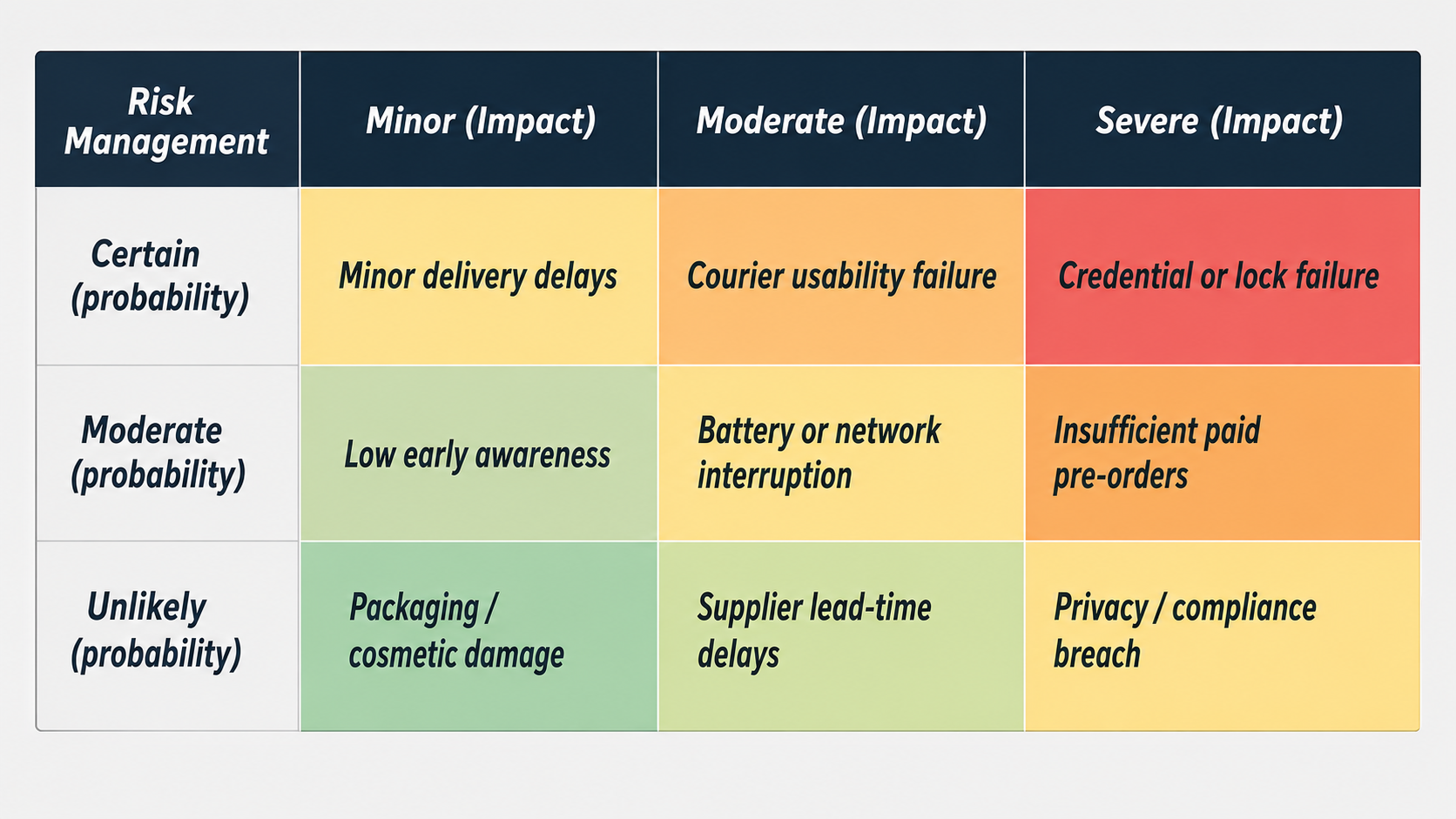
Risk matrix
SecureBox risk matrix plotting likelihood against impact for credential failure, courier usability and supplier cost risk
Risks ranked by likelihood and impact.
Risk register
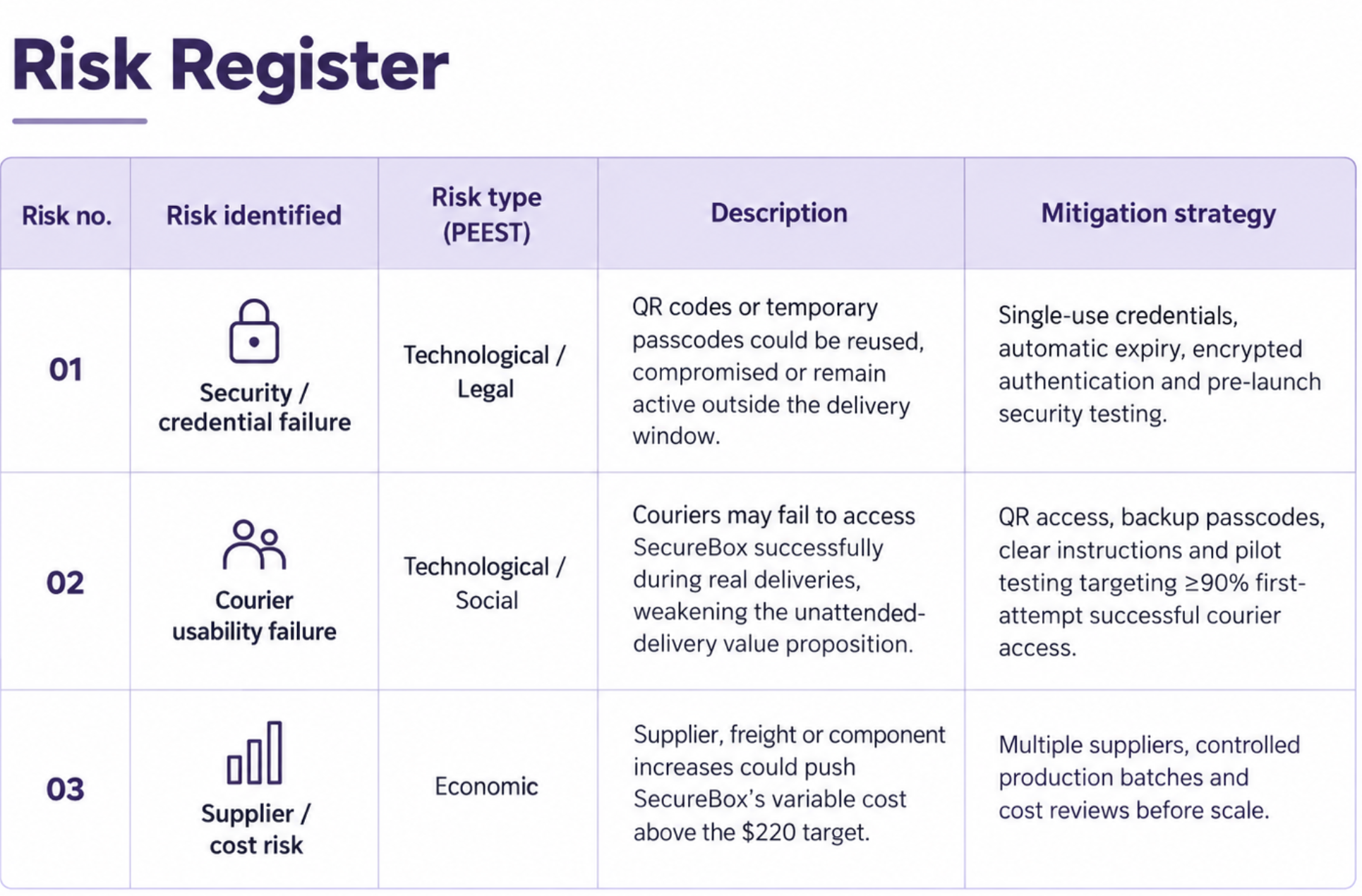
Risk register: 01 security / credential failure (Technological / Legal), 02 courier usability failure (Technological / Social), 03 supplier / cost risk (Economic), with descriptions and mitigation strategies
Detailed risk response and mitigation → Strategy
11Responsible business

Evaluating social, environmental, ethical and economic impacts before commercial launch.

Social

Accessibility

SecureBox can reduce unattended-delivery risk, while keypad and owner-access alternatives improve accessibility. Payment options and shared installations could reduce price and renter barriers.

Environmental

Product lifecycle

Durable construction, replaceable modules, repair services, recyclable packaging and responsible battery/e-waste disposal can reduce lifecycle waste.

Ethical

Privacy and data

Camera monitoring improves delivery verification but creates privacy risk. Delivery-area-only positioning, data minimisation, limited retention and customer-controlled deletion protect stakeholder trust.

Economic

Supply resilience

Local assembly retains economic value, while imported electronics create supply-chain exposure.

Local control, global dependence

Adelaide assembly and testing allow SecureBox to maintain closer quality control, support local jobs and provide faster customer support while retaining some economic value locally. However, cameras, electronic locks and control boards may still depend on overseas suppliers, exposing the business to freight delays, exchange-rate movements, supplier concentration and e-waste impacts. Global sourcing lowers development and manufacturing barriers, but SecureBox should reduce this dependence through multiple suppliers, replaceable modules and controlled production batches while keeping final assembly and testing in Adelaide.
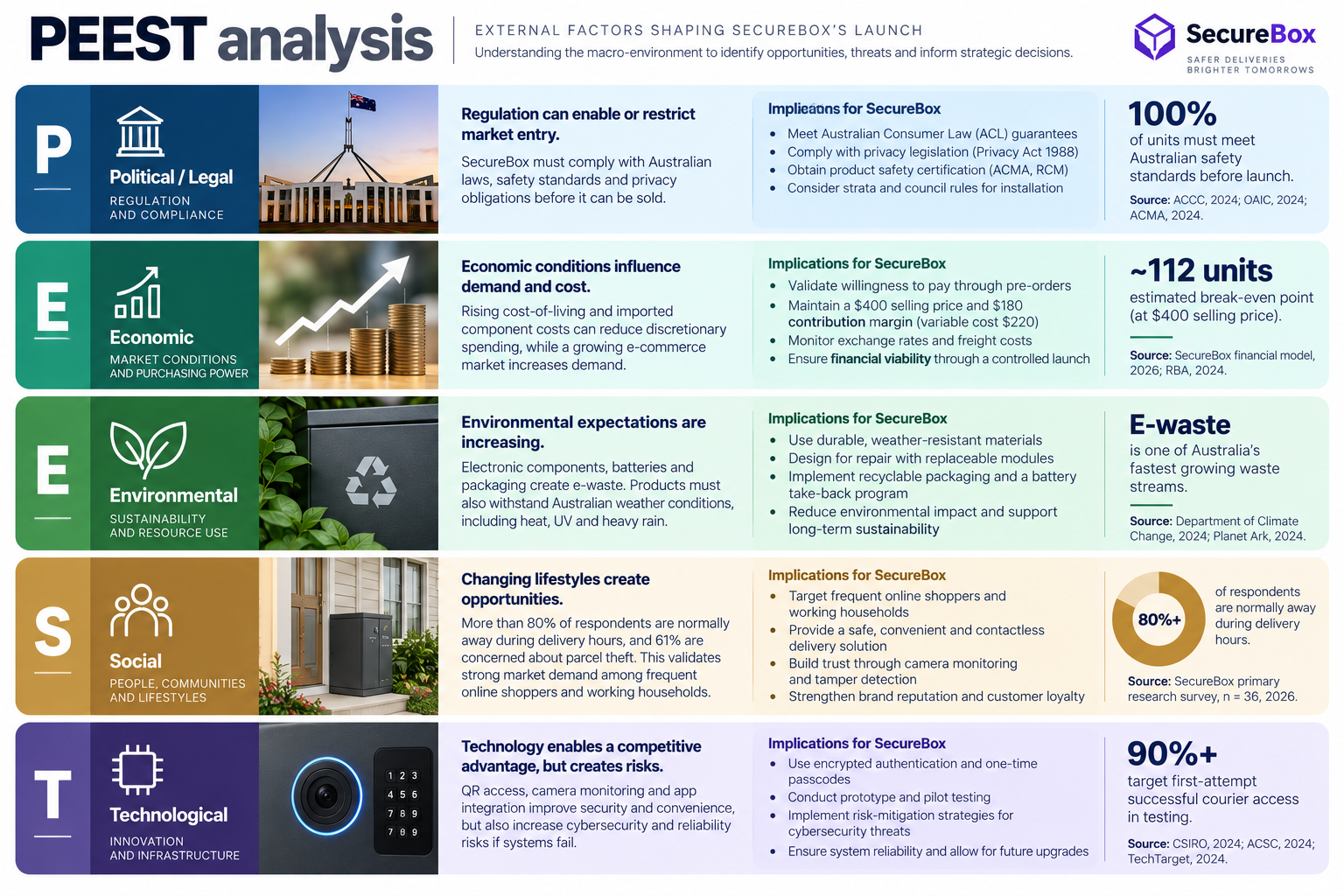
PEEST analysis
PEEST analysis: external factors shaping SecureBox's launchPEEST analysis identifies the external factors shaping SecureBox’s launch and the business responses required before scaling.
The market

More parcels. More unattended deliveries. A growing need for security.

Online shopping has made unattended delivery routine. SecureBox targets frequent online shoppers who are often away during deliveries.

Explore the evidence
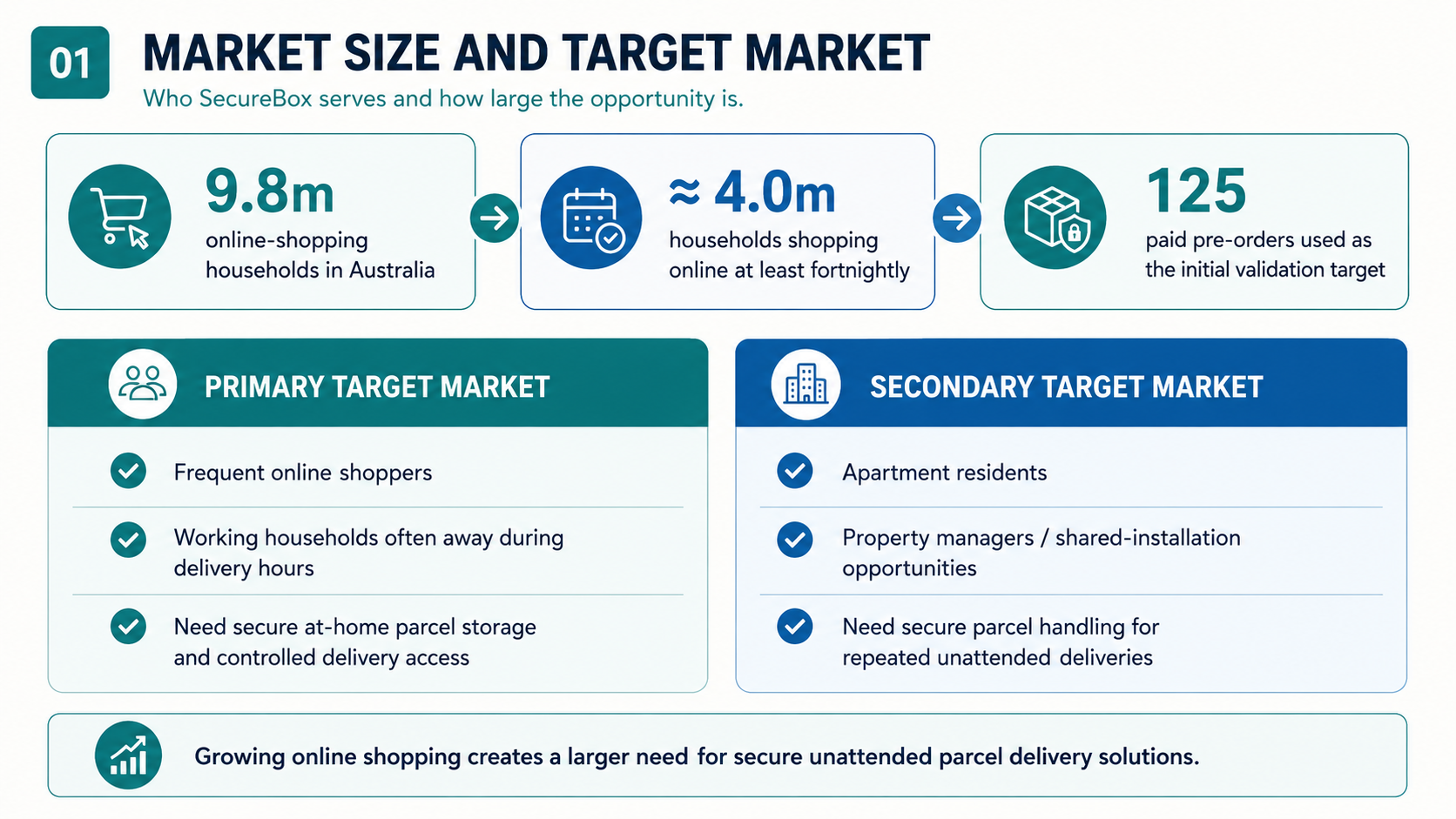
01Market opportunity
Market size and target market infographic: 9.8 million online-shopping households narrowing to 4 million frequent shoppers and 125 paid pre-orders, with primary and secondary target markets
Australian online shopping9.8M households(Australia Post, 2026)
High-frequency online shoppers≈4.0M households(Australia Post, 2026)
SecureBox target segmentFrequent, often-away shoppersFrequent online shoppers who are regularly away during delivery hours.(SecureBox Primary Research, 2026)
Validation gate125 paid pre-ordersSecureBox internal viability threshold before larger-scale production.(SecureBox Financial Model, 2026)

Australia’s 9.8 million online-shopping households establish a substantial addressable market, with approximately 4.0 million shopping at least fortnightly: a SecureBox calculation based on cited secondary data (Australia Post, 2026). SecureBox narrows this opportunity to frequent shoppers who are regularly away during deliveries (SecureBox Primary Research, 2026); however, market size alone does not demonstrate commercial demand, so paid pre-orders remain the validation gate before larger production (SecureBox Financial Model, 2026).

02Target customer
Primary target segmentEvidence-supported initial focus
Frequent online shoppers
Regularly away during delivery hours
Concerned about unattended parcel security

Primary research indicates stronger problem-solution fit among frequent online shoppers who are regularly away during delivery hours, with more than 80% reporting this behaviour and 61% expressing theft concern.

Secondary marketFuture market hypothesis, not yet validated
Apartment residents
Property managers
Residential developments

Apartment residents, property managers and residential developments remain future market hypotheses because they have not yet been validated through primary research.
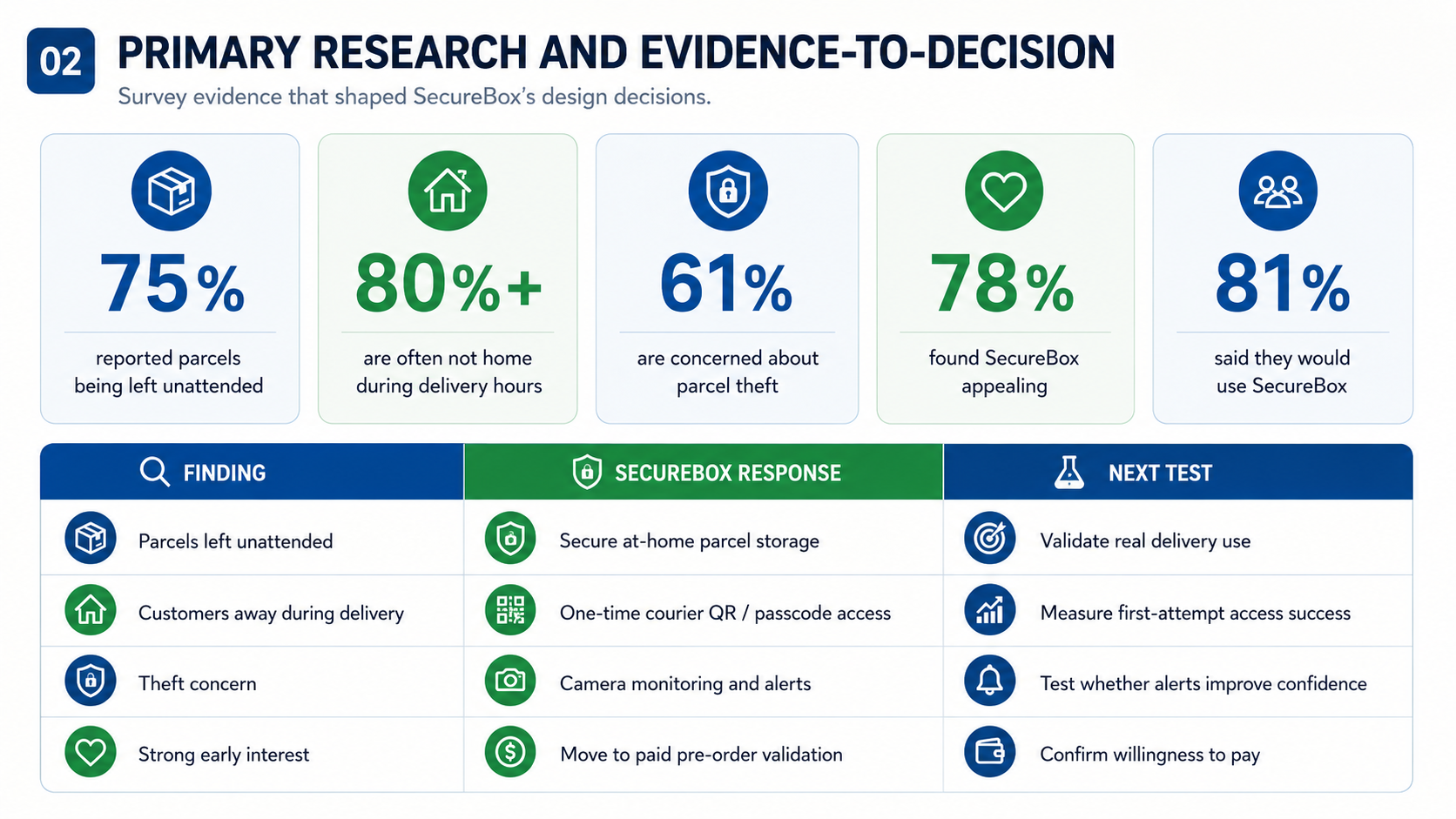
03Primary research · n = 36
Primary research infographic: 75% reported unattended parcels, 80%+ often away, 61% theft concern, 78% found SecureBox appealing and 81% would use it, with a finding, SecureBox response and next test table
75%Experienced unattended parcels(SecureBox Primary Research, 2026)
80%+Normally away during delivery hours(SecureBox Primary Research, 2026)
61%Concerned about parcel theft(SecureBox Primary Research, 2026)
78%Found the SecureBox concept appealing(SecureBox Primary Research, 2026)
81%Indicated they would use SecureBox(SecureBox Primary Research, 2026)
Evidence80%+ normally away during delivery hours(SecureBox Primary Research, 2026)
DecisionPrioritise remote, temporary courier access.
Evidence61% concerned about parcel theft(SecureBox Primary Research, 2026)
DecisionInclude tamper detection, camera monitoring and instant alerts.
Evidence78% appeal · 81% would use SecureBox(SecureBox Primary Research, 2026)
DecisionTest whether stated customer interest converts into actual willingness to purchase at the proposed $400 price.

The survey provides initial customer validation, not proof of commercial demand. The n = 36 self-selected sample creates sampling bias and generalisability limitations, while stated interest may not translate into purchase behaviour (SecureBox Primary Research, 2026). SecureBox must therefore test revealed demand through paid pre-orders at the proposed $400 price.
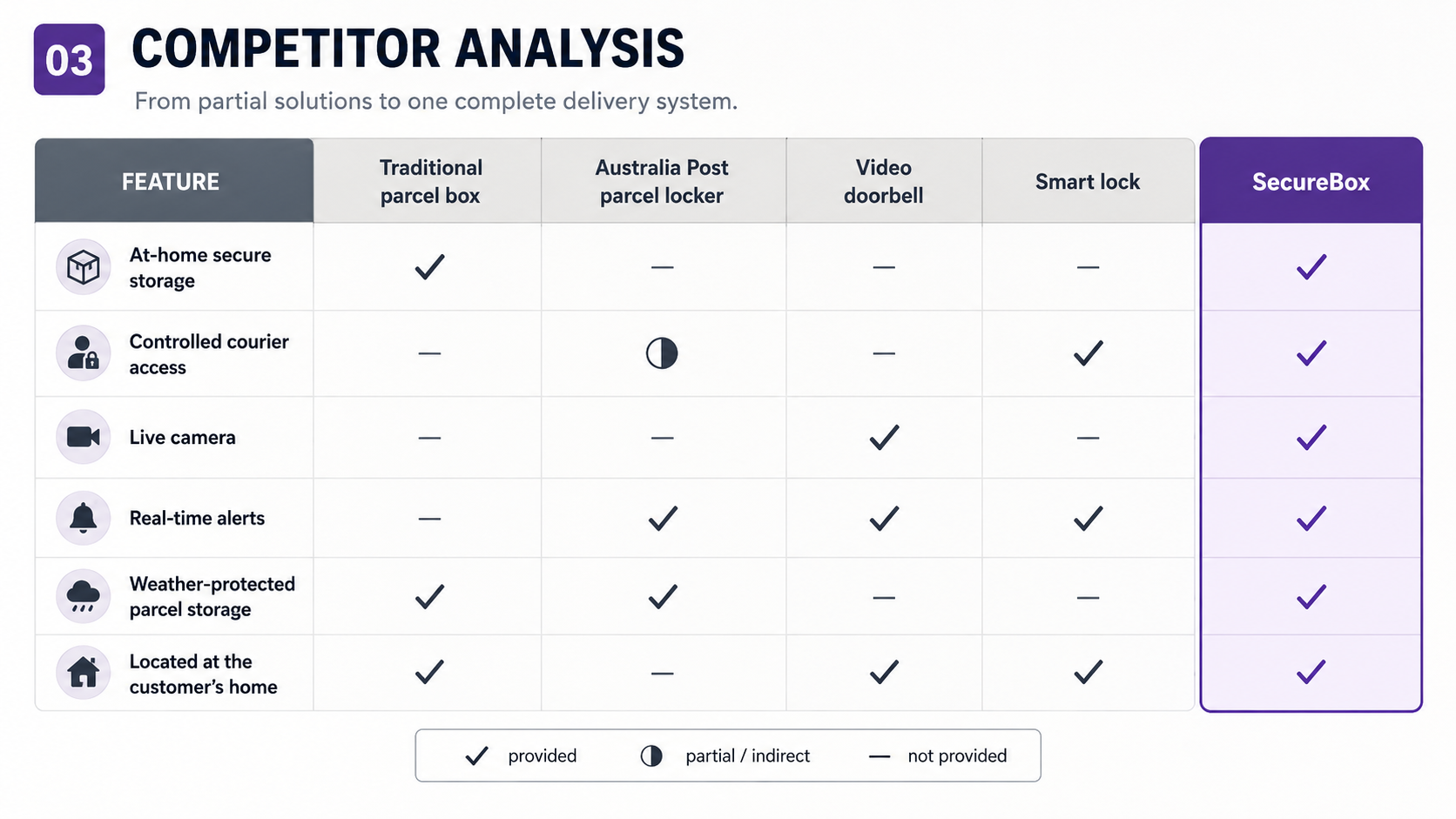
04Competition
Competitor analysis table comparing traditional parcel box, Australia Post parcel locker, video doorbell, smart lock and SecureBox across at-home secure storage, controlled courier access, live camera, real-time alerts, weather protection and home location

Competitor analysis shows that existing alternatives solve separate parts of the unattended-delivery problem (Australia Post, 2026; Ring, 2026). SecureBox’s proposed competitive advantage is differentiation through at-home secure storage, temporary courier access and delivery verification within one integrated system.
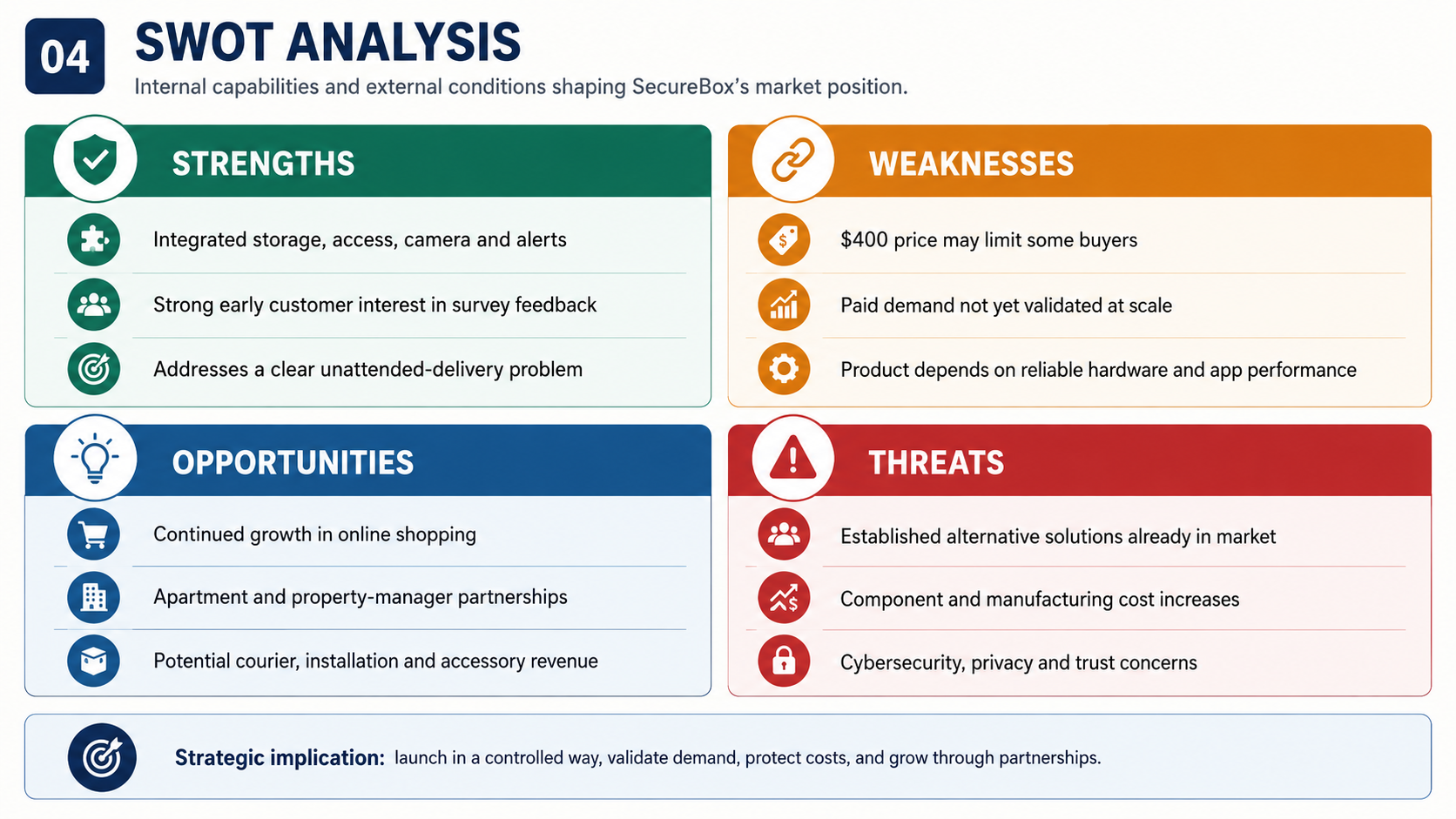
05SWOT analysis
SecureBox SWOT analysis infographic showing strengths, weaknesses, opportunities and threats with a strategic implication strip
StrengthIntegrated storage, temporary access and monitoringEvidence: competitor analysis of existing alternatives.(Australia Post, 2026; Ring, 2026)
Weakness$400 proposed price may create an adoption barrierEvidence: willingness to pay has not yet been commercially validated.(SecureBox Financial Model, 2026)
OpportunityLarge and frequent Australian online-shopping marketEvidence: 9.8M households shopped online and 41% shopped at least fortnightly.(Australia Post, 2026)
ThreatEstablished parcel-collection and home-security alternativesEvidence: existing Australia Post locker network and smart-home security products.(Australia Post, 2026; Ring, 2026)

The SWOT supports a differentiation strategy rather than price-based competition. However, the $400 price remains a commercial hypothesis, so willingness to pay must be validated before larger production commitments are made.

06Get–Keep–Grow & market decision

Get–Keep–Grow model

GET KEEP GROW AWARENESS › INTEREST › PURCHASE RETAIN CUSTOMERS UPSELL › REFERRALS REFERRAL LOOP
Get Proposed acquisition
Targeted digital advertising
Target frequent online shoppers with problem-focused digital advertising.
Product demonstrations
Demonstrate QR/passcode access, automatic locking and delivery verification.
Retail exposure
Trial selected electronics retailers only after initial demand validation.
Keep Proposed retention
Warranty and after-sales support
Reduce ownership risk through repair, replacement and troubleshooting support.
App and software support
Maintain access, notification and security functions through technical updates.
Responsive customer service
Resolve installation, access and product issues quickly to protect customer trust.
Grow Proposed customer-value expansion
Referrals
Use positive ownership experiences to generate lower-cost customer acquisition.
Accessories
Offer compatible replacement modules and add-ons to increase customer value.
SecureBox+
Test optional digital services as a future recurring-revenue opportunity.
Property partnerships
Test apartment and residential-development channels only after household demand is validated.

At launch, customer acquisition and trust are the priority. Retention, referral and additional revenue strategies will be expanded only when actual conversion, support and customer data justify further investment.

Market decision: validate before scaling
01Price validation
$400Will customers convert stated interest into paid demand at the proposed launch price?(SecureBox Financial Model, 2026)Commercial hypothesis
02Usability validation
≥90%Can couriers successfully complete first-attempt delivery access without assistance?(SecureBox Pilot Acceptance Target, 2026)Internal acceptance threshold
03Demand validation
125Is paid pre-order demand sufficient to justify larger-scale production?(SecureBox Financial Model, 2026)Internal viability gate
Validate
Meet all critical thresholdsControlled launchEvaluateScale
Threshold missed
PivotPrice / product / target segmentRetest

SecureBox will scale only when paid demand, price acceptance and courier usability meet their defined thresholds; any failed threshold triggers targeted revision and re-testing before further investment.

04Strategy

From prototype to proven market.

SecureBox uses a staged market-entry strategy, progressing only when customer demand, product reliability and financial evidence support the next stage.
{{ st.num }}
{{ st.label }} {{ st.sub }}
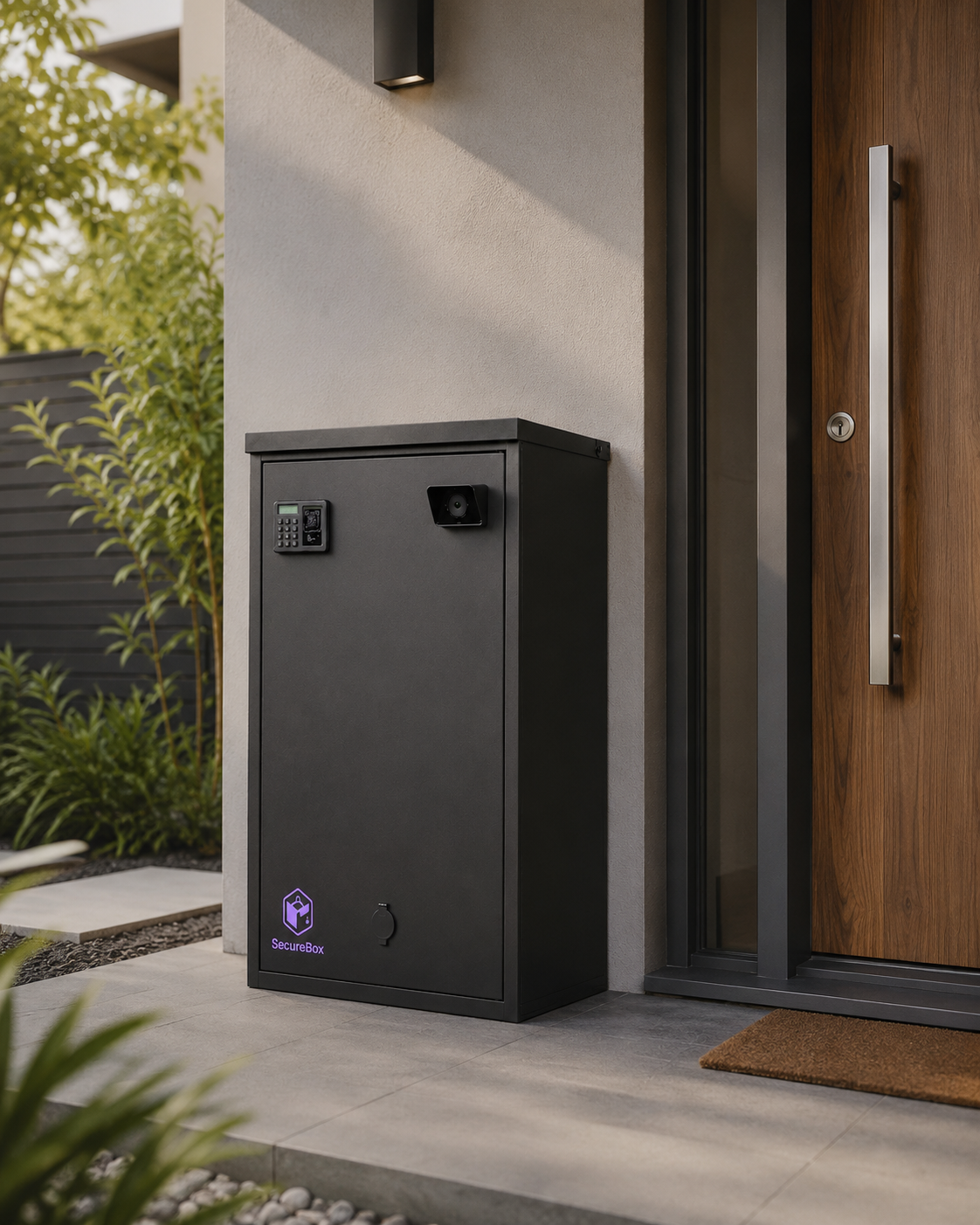
SecureBox installed beside the front door of a modern home in daylight
02Action plan

12-month action plan

From customer validation to an evidence-based scale decision.
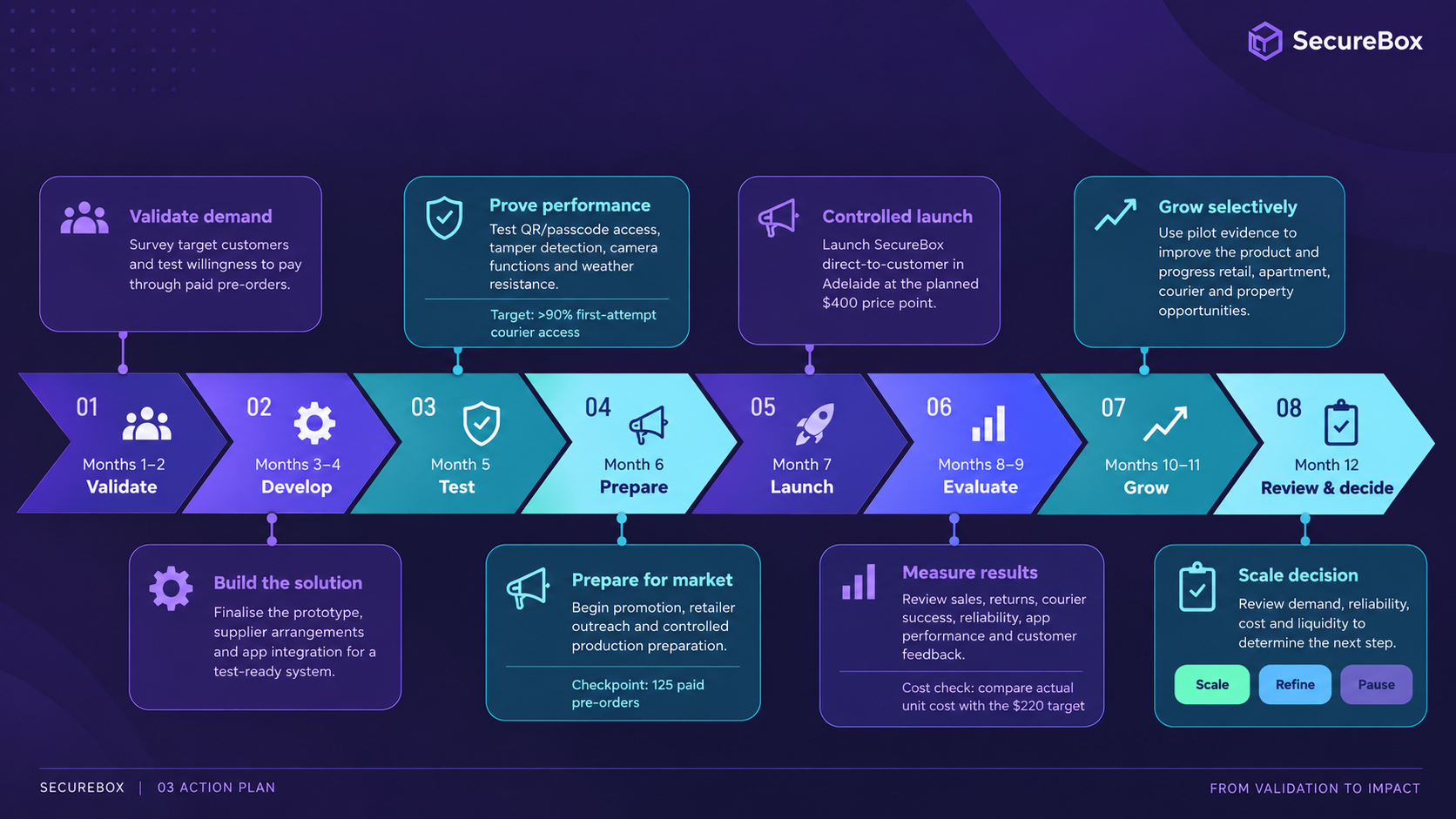
SecureBox 12-month action plan timeline: validate, develop, test, prepare, launch, evaluate, grow, review and decide
Evidence → evaluation → change

Primary research provided initial evidence that unattended deliveries and parcel security were genuine customer problems, but interest alone did not prove willingness to pay. Because immediate scaling would expose SecureBox to demand, technical and financial risk, the plan was revised to require 125 paid pre-orders before larger production. Prototype testing then provides further evidence through ≥90% first-attempt courier access and 100% rejection of reused or expired credentials before launch.

03Strategic goals

Strategic goals

Three priorities SecureBox must achieve in the first 12 months.
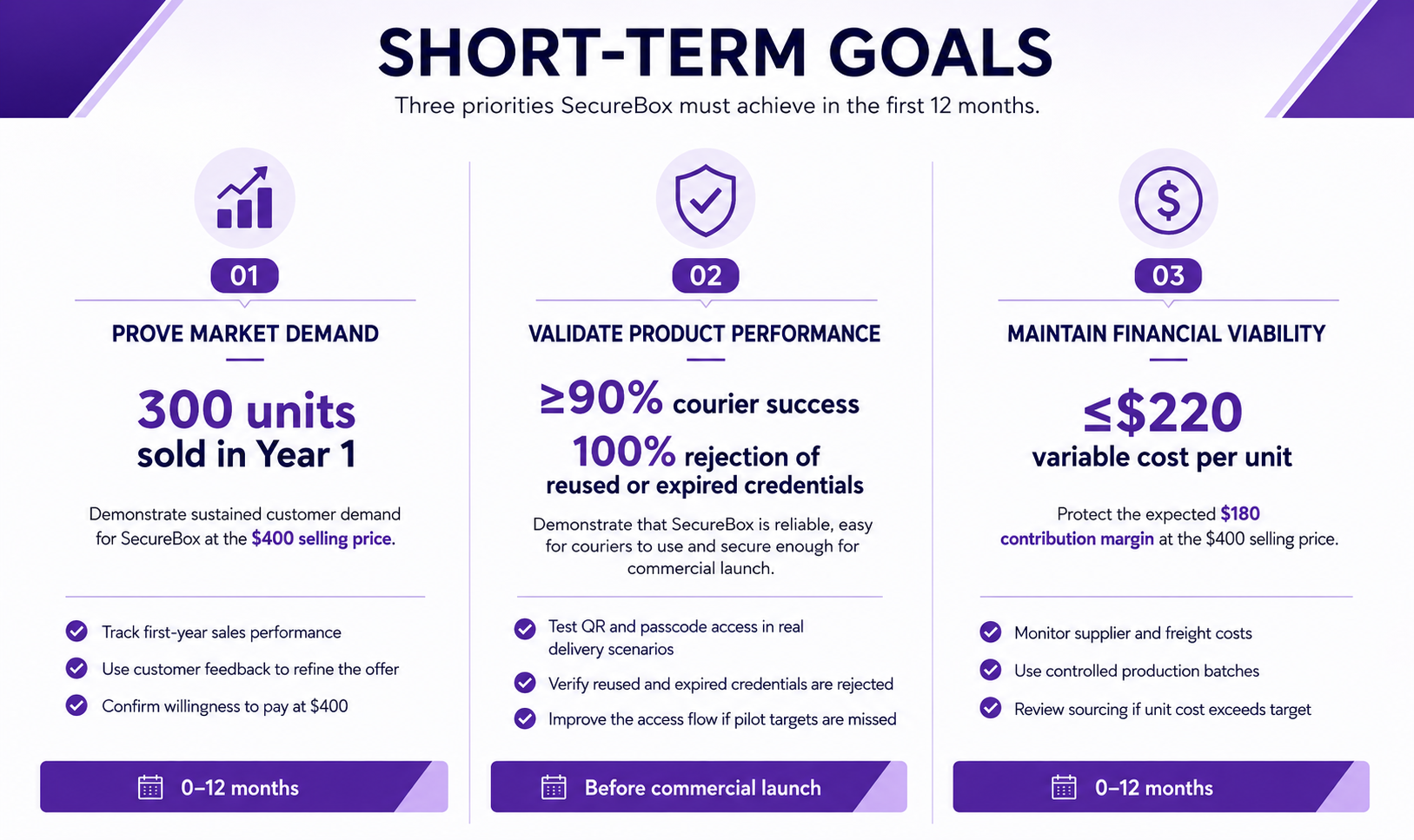
SecureBox short-term goals: prove market demand, validate product performance and maintain financial viability

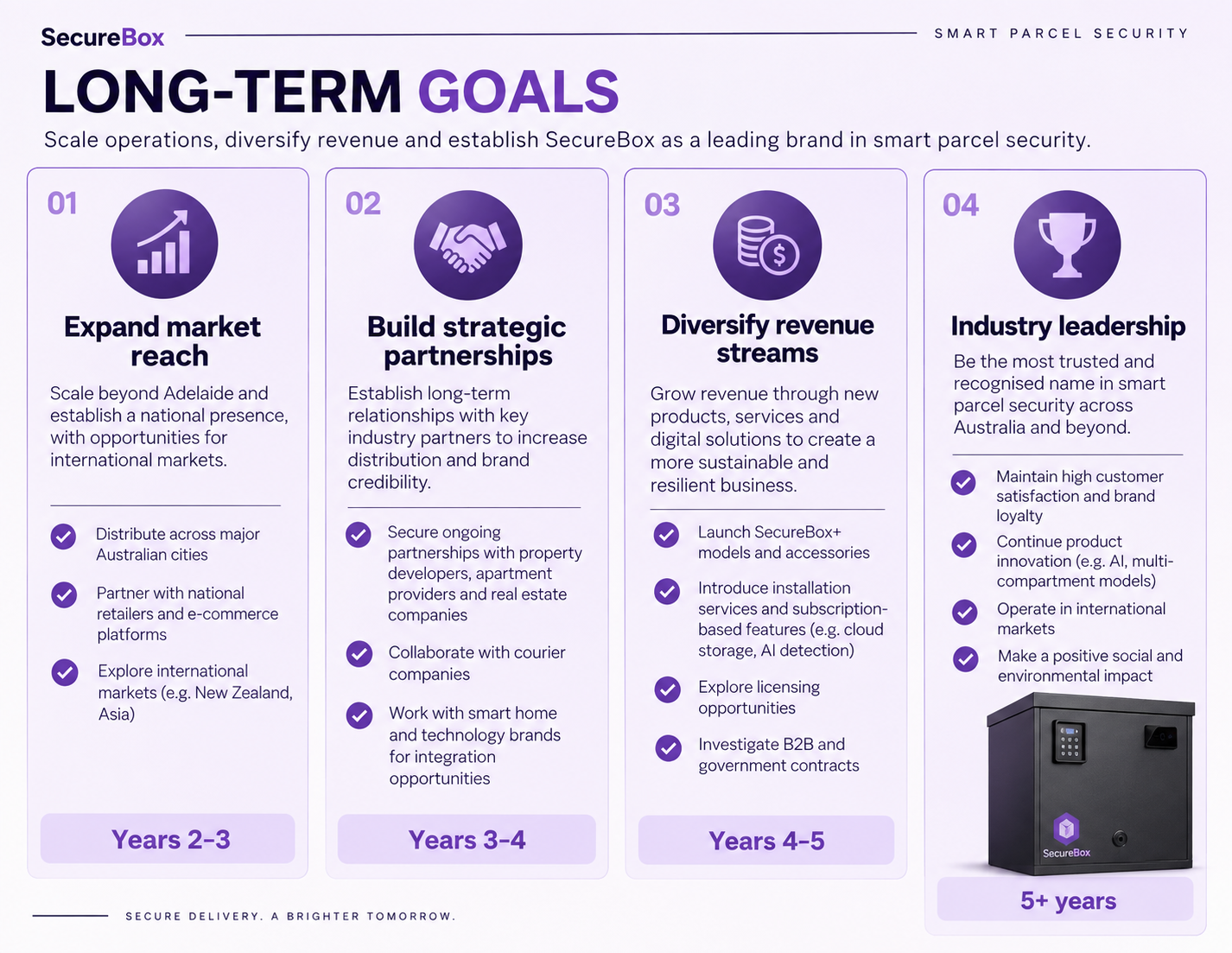
Long-term goals

SecureBox long-term goals: expand market reach, build strategic partnerships, diversify revenue streams and achieve industry leadership
04Risk and mitigation

Risk response and mitigation

Controls, success targets and decision thresholds for the three launch-critical risks.

Key risks and mitigation
Imported electronic components, freight and shipping representing supply-cost risk
01High

Supplier / cost risk

Control

Multiple suppliers · controlled production batches · pre-scale cost reviews

Success target≤$220Confirmed variable cost per unit before approving a larger production run.
If missedRe-source components → review specification or selling price → reassess scale
SourceSecureBox financial model, 2026
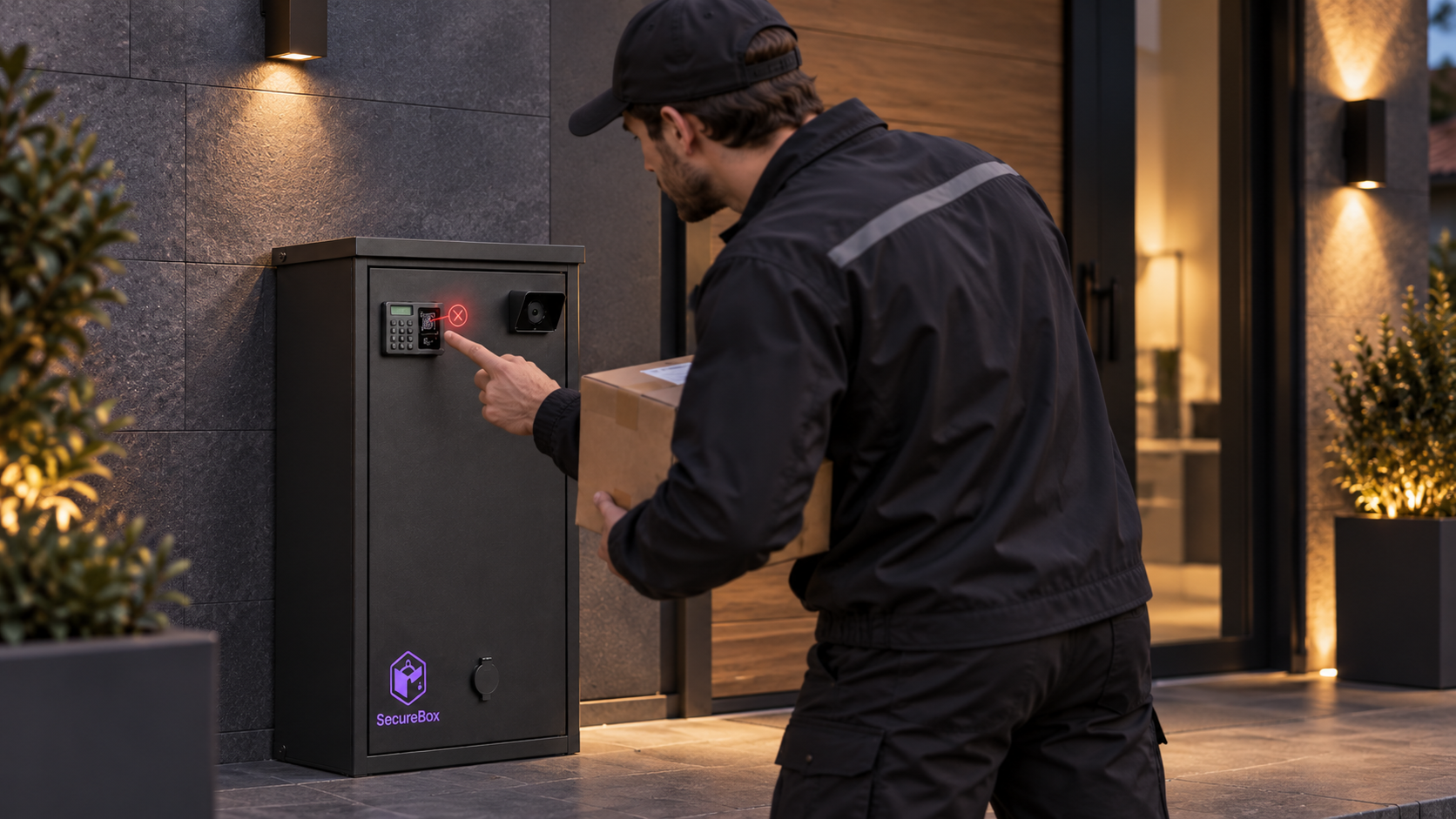
Courier holding a parcel unable to access SecureBox at a front entrance
02Critical

Courier usability failure

Control

QR access · backup passcode · clear physical instructions · pilot testing

Success target≥90%First-attempt successful courier access during the pilot.
If missedHold production → revise access flow and instructions → retest
Evidence sourceSecureBox Primary Research Survey, n = 36, 2026Success thresholdSecureBox Pilot Acceptance Target, 2026
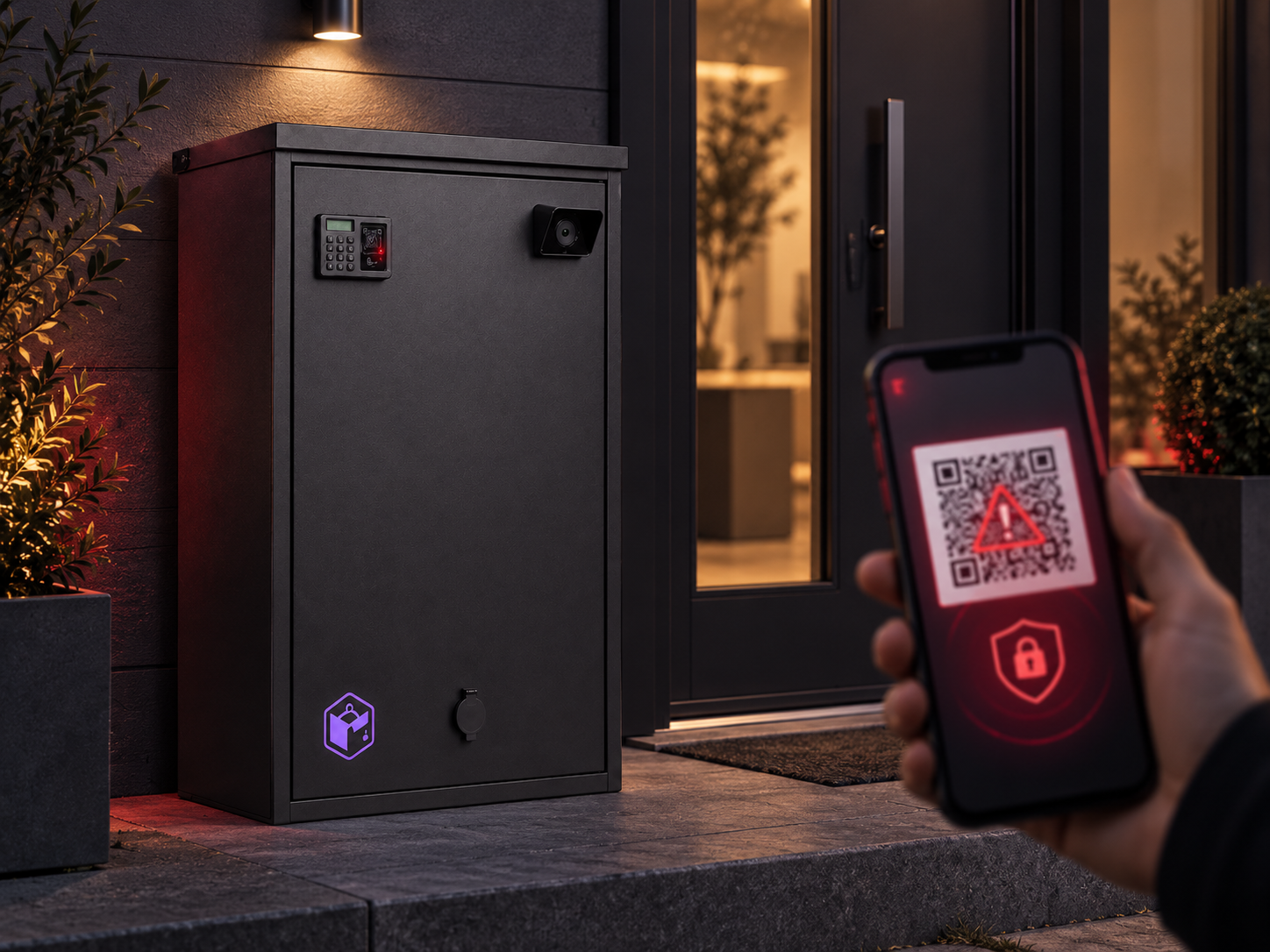
SecureBox at a residential entrance with a phone showing an invalid QR credential
03Critical

Security / credential failure

Control

Single-use credentials · automatic expiry · encrypted authentication · pre-launch security testing

Success target100%Reused or expired credentials rejected during controlled testing.
If missedDelay launch → rebuild access control → retest
Compliance contextOAIC, Australian Privacy Principles, APP 11Success thresholdSecureBox Launch Control Target, 2026

Before sale, SecureBox must confirm applicable product-safety, electrical/EMC, battery, labelling and Australian Consumer Law requirements.

05Growth opportunities

Growth opportunities

Growth opportunities will be pursued only after the Adelaide launch demonstrates validated demand, product reliability and financial viability.
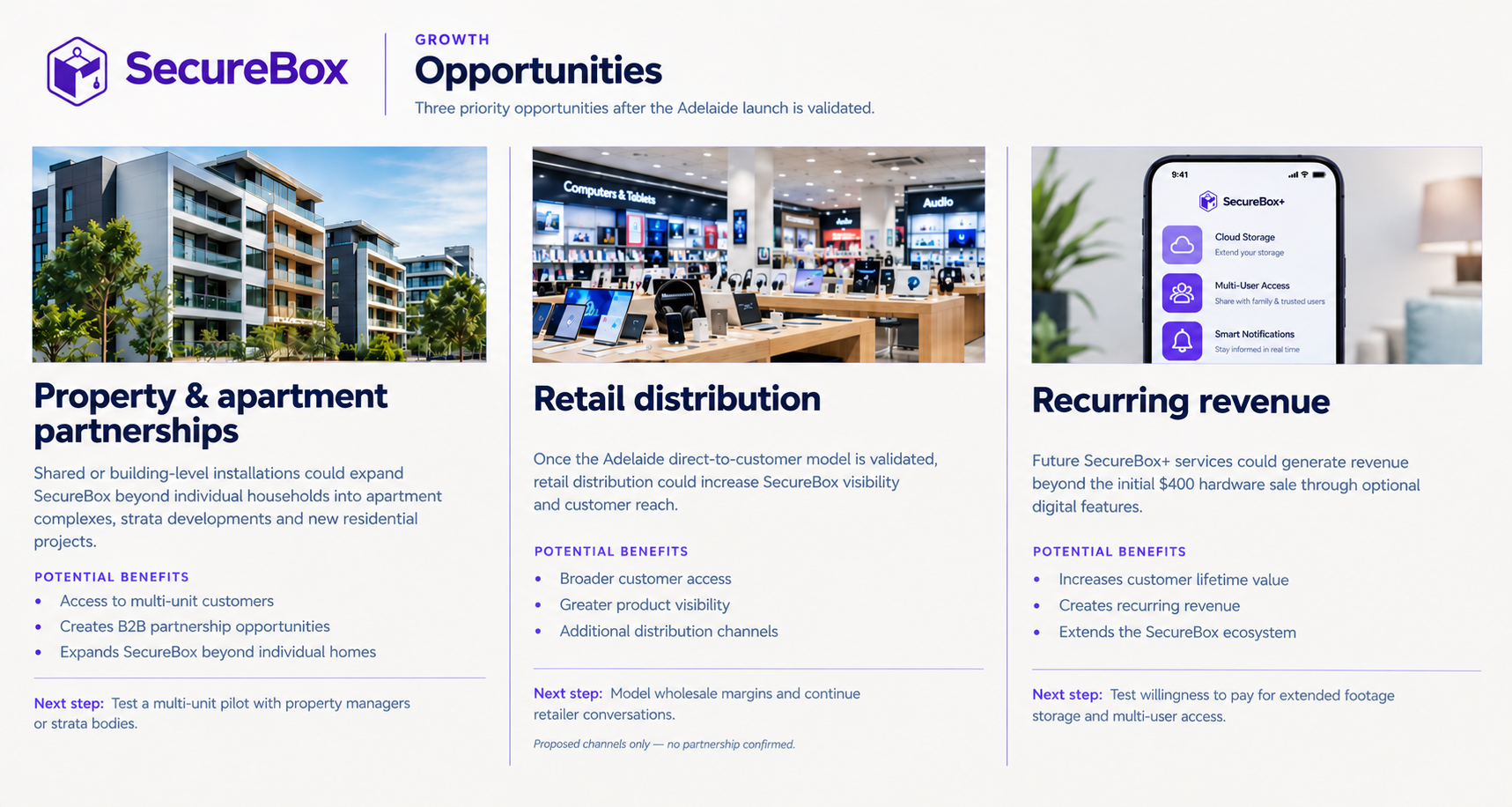
SecureBox growth opportunities: property and apartment partnerships, retail distribution and recurring revenue
06Evaluate, adapt & scale

Evaluate. Adapt. Scale.

Year-one decision rules
Scale

If ≥125 paid pre-orders, variable cost ≤$220, ≥90% courier success and security targets are met → increase controlled production and consider expansion.

Refine

If demand is strong but usability or reliability targets are missed → fix the issue, retest and remain at pilot scale.

Reassess

If demand, security or financial viability cannot be demonstrated → pause expansion and reassess price, product scope or business model.

SecureBox does not scale because time has passed; it scales when demand, usability, security and financial evidence support the decision.

04 Finance

Can SecureBox make money at scale?

Financial modelling tests whether SecureBox can move from concept to a financially sustainable controlled launch.

{{ m.value }}
{{ m.label }}
01Financial objectives

Financial objectives

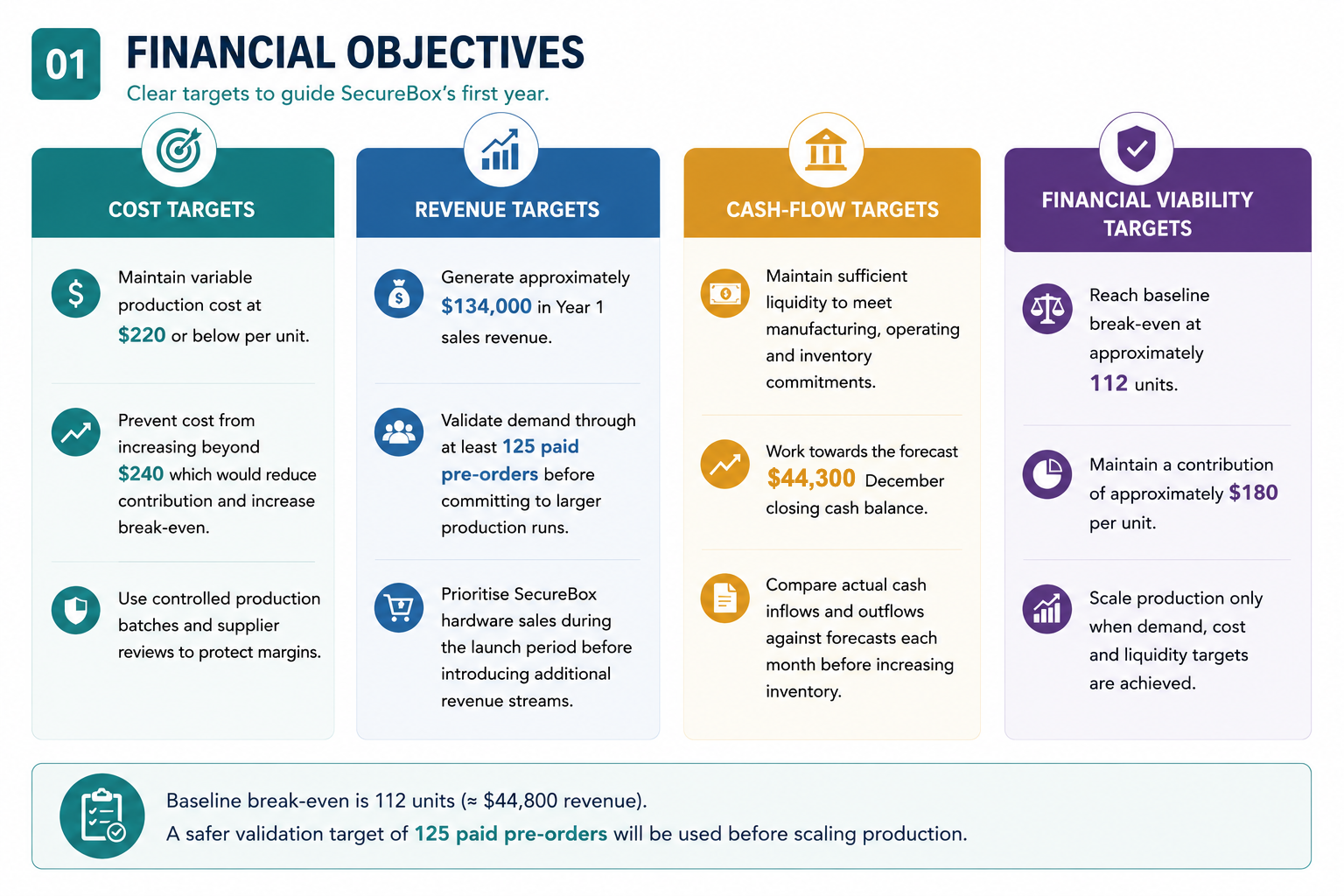
SecureBox financial objectives: cost, revenue, cash-flow and viability targets

Financial forecasts are presented on a pre-GST basis for consistency. SecureBox targets a $220 variable cost, a $180 contribution per unit and positive operating viability. The 125 paid pre-orders are the pre-launch validation gate, 300 units is the strategic Year 1 sales objective, and 335 units is the central financial forecast scenario.

02Start-up costs

Business start-up costs

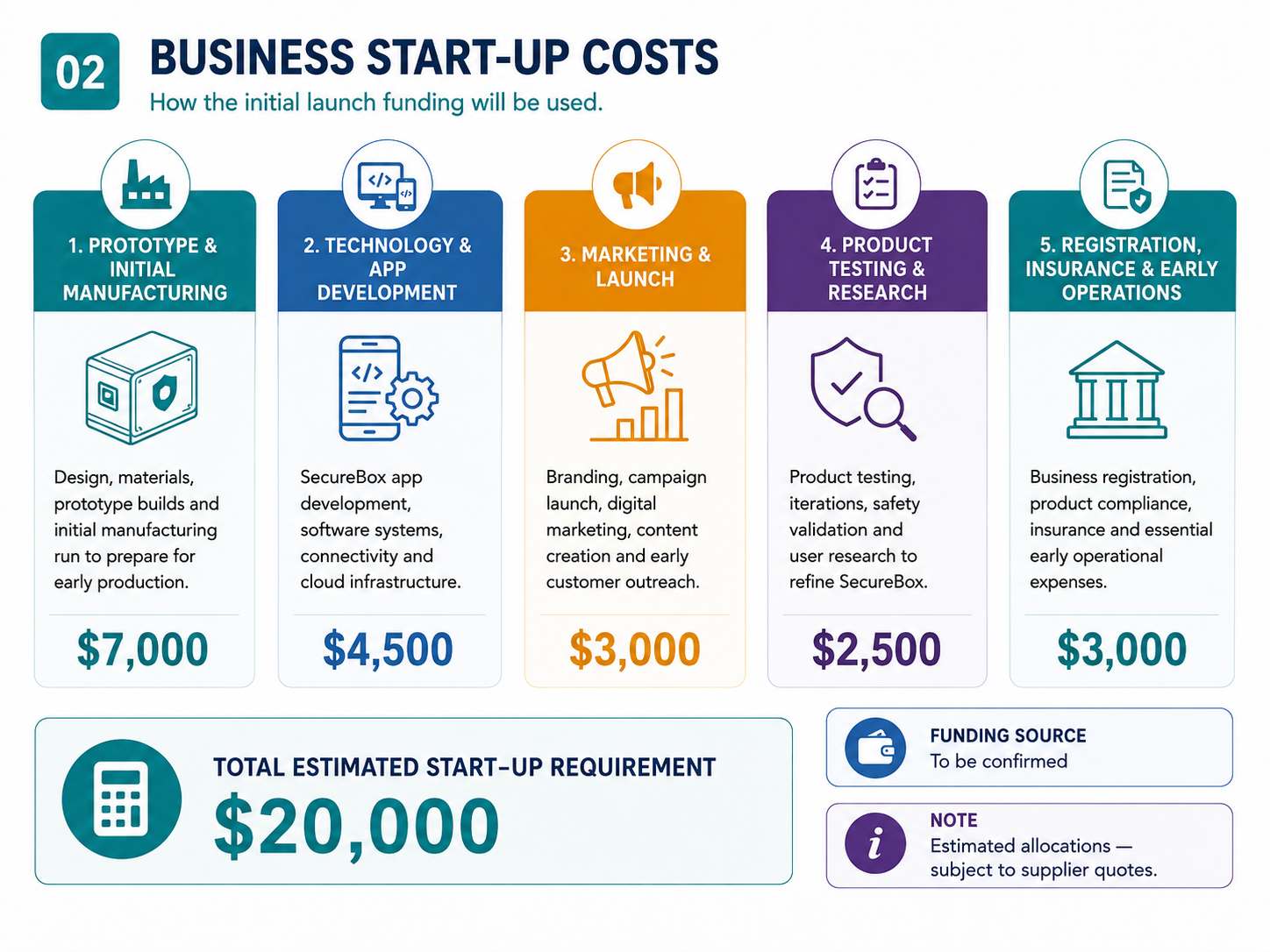
SecureBox start-up cost allocation totalling $20,000
How the $20,000 estimate was validated

The $20,000 start-up capital requirement is an evidence-based estimate informed by supplier consultation and cross-checked against expected technology, testing, registration, insurance and compliance costs. Formal supplier quotations will be obtained before production commitments are made.

Proposed funding source$20,000 founder equity / owner capital

The proposed $20,000 capital requirement will be funded through founder equity, avoiding loan repayments and interest during customer validation. This preserves early cash flow, although the founder carries the initial financial risk. External finance would only be considered after validated demand supports expansion.

03Pricing

Pricing considerations

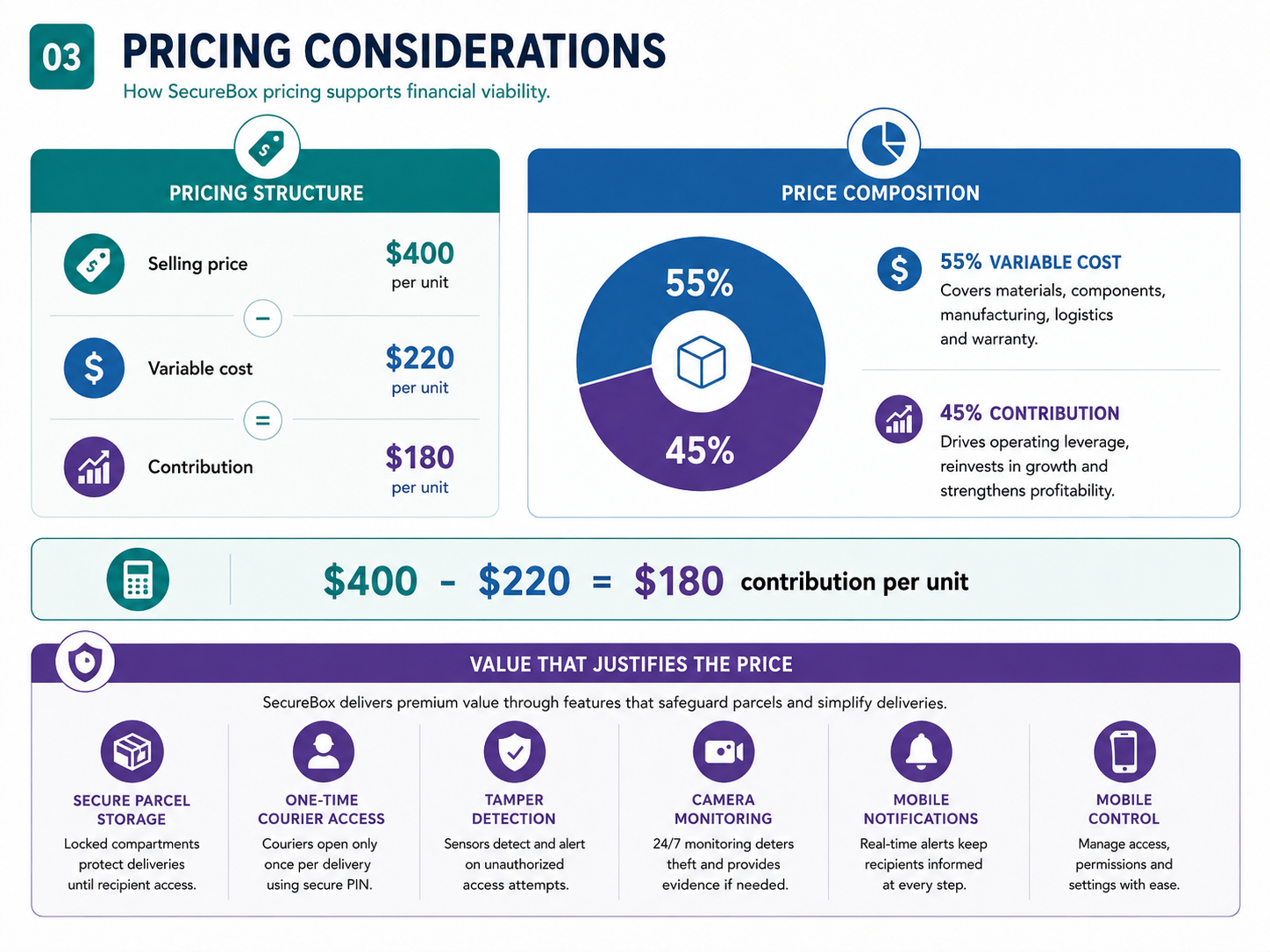
SecureBox pricing structure, price composition and the value that justifies the price
$400−$220=$180 contribution45% contribution margin
How the $220 estimate is built: estimated categories, not supplier quotes
Enclosure + anchoring
Electronics / control board
Camera + sensors
Lock + access hardwareElectronic locking and courier-access components
Battery / powerBackup and connected operation
Assembly / packagingPer-unit completion cost

The $220 variable cost remains a working production estimate. At a $400 selling price, SecureBox generates a $180 contribution per unit; however, supplier, freight or assembly increases would reduce the contribution margin and increase break-even volume.

Why $400?
ValueIntegrated parcel security, controlled courier access and delivery verification.
PositioningDifferentiation rather than lowest-price competition.
ValidationPaid pre-orders must test willingness to pay at $400.
See competitor analysis →
04Future revenue

Future revenue opportunities

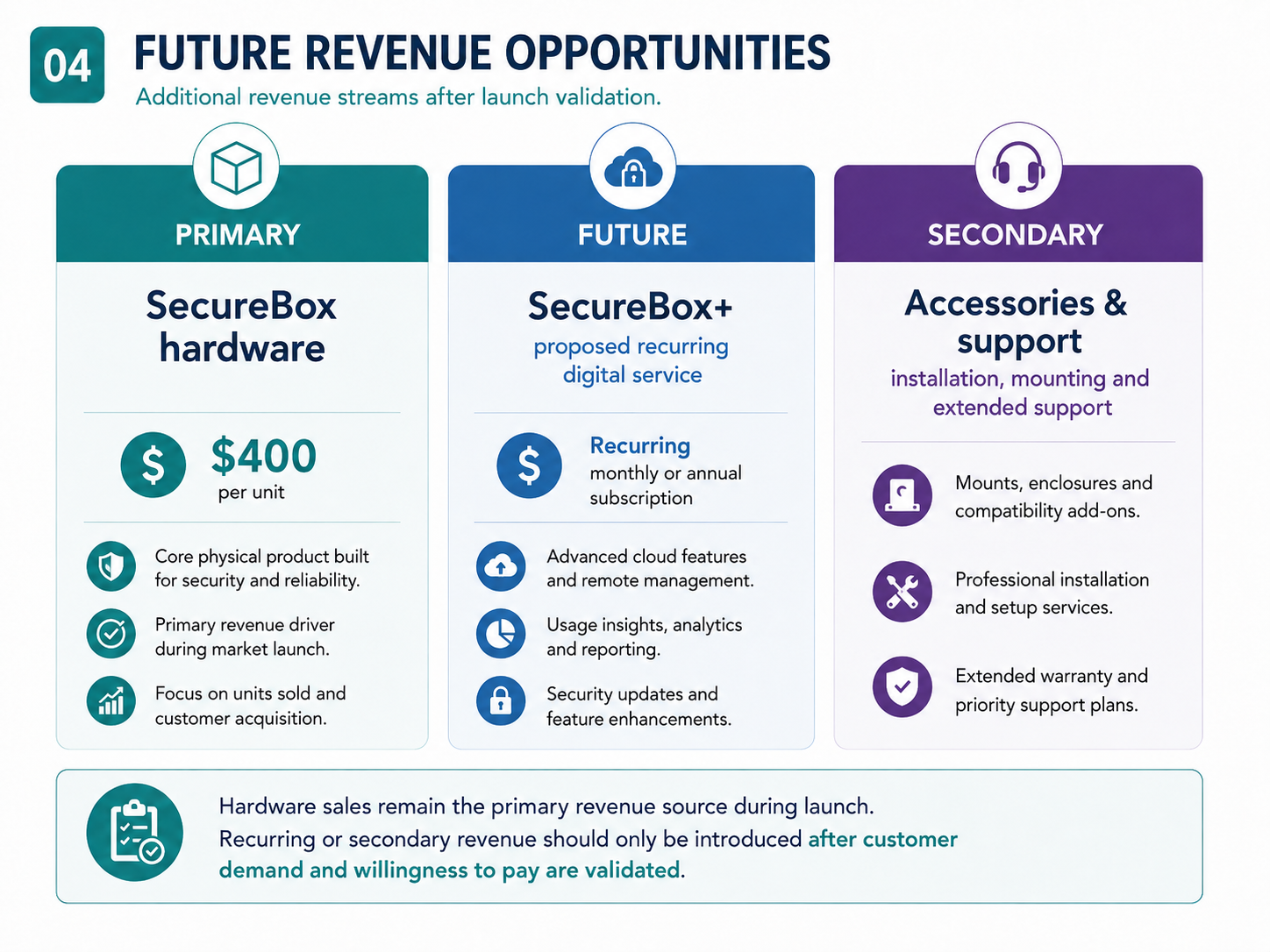
Primary, future and secondary SecureBox revenue streams

Hardware sales remain the primary launch revenue stream. SecureBox+, installation, accessories and extended support are future revenue opportunities to test only after demand for the core product is validated.

05Cash flow

Cash-flow forecast summary

MonthUnitsClosing cash
Jan8$107
Feb12$934
Mar16$2,481
Apr20$4,748
May24$7,735
Jun28$11,442
Jul30$15,509
Aug32$19,936
Sep34$24,723
Oct40$30,590
Nov44$37,177
Dec47$44,300
Year 1 total335$44,300

The cash-flow forecast tests SecureBox’s liquidity under the 335-unit Year 1 scenario, ending with $44,300 closing cash. Closing cash should be monitored monthly because actual demand, supplier costs and operating expenditure may differ from forecasts; production or marketing expenditure should increase only when liquidity remains sufficient.

Annual budget

Year 1 budget

Budget itemYear 1 forecast
Sales revenue$134,000
Variable production costs$73,700
Contribution$60,300
Start-up requirement$20,000
Operating expenses$16,000
Forecast net profit before tax$24,300

The Year 1 budget provides the financial targets against which actual monthly performance will be monitored.

06Break-even

Break-even analysis

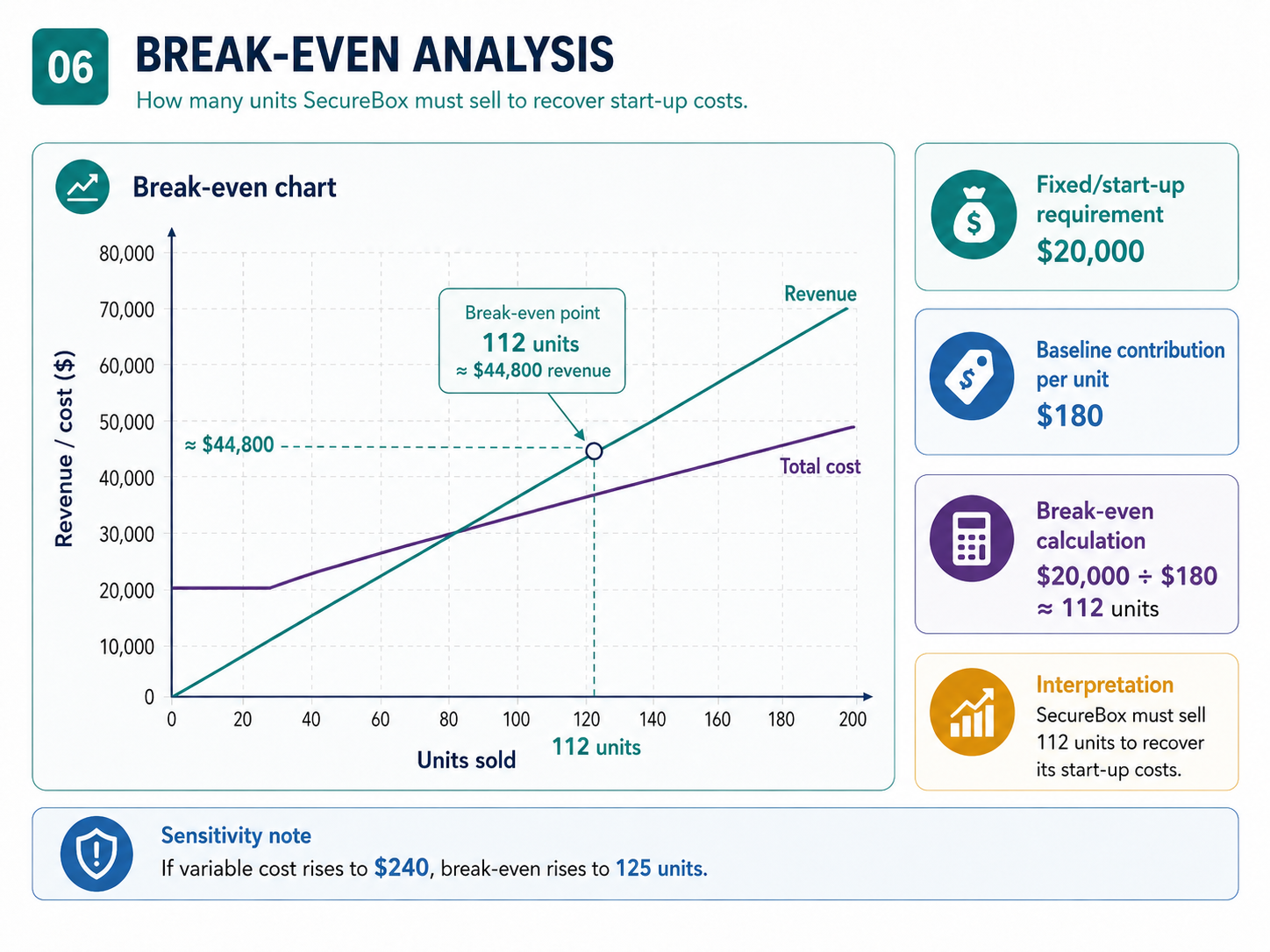
SecureBox break-even chart showing 112 units and approximately $44,800 revenue
$20,000÷$180 contribution≈112 unitsStart-up cost recovery point
Start-up cost recovery point≈112 units$20,000 ÷ $180 contribution, ≈$44,800 in sales revenue.
Full Year 1 operating break-even≈200 units($20,000 start-up requirement + $16,000 operating expenses) ÷ $180 contribution, treating the $16,000 as fixed Year 1 costs.
If variable cost rises to $240≈125 unitsContribution falls to $160 per unit.

The baseline 112-unit figure represents recovery of the modelled $20,000 start-up requirement. When the additional $16,000 Year 1 operating expenses are included, the full operating break-even increases to approximately 200 units. This highlights the importance of controlling fixed costs and validating demand before scaling. Separately, the sensitivity analysis tests supplier cost risk against the start-up recovery point: a rise in variable cost from $220 to $240 lifts that point from approximately 112 to 125 units. Firm supplier quotations and controlled production therefore reduce financial risk before scaling.

07Profit / loss

Income and profit / loss forecast

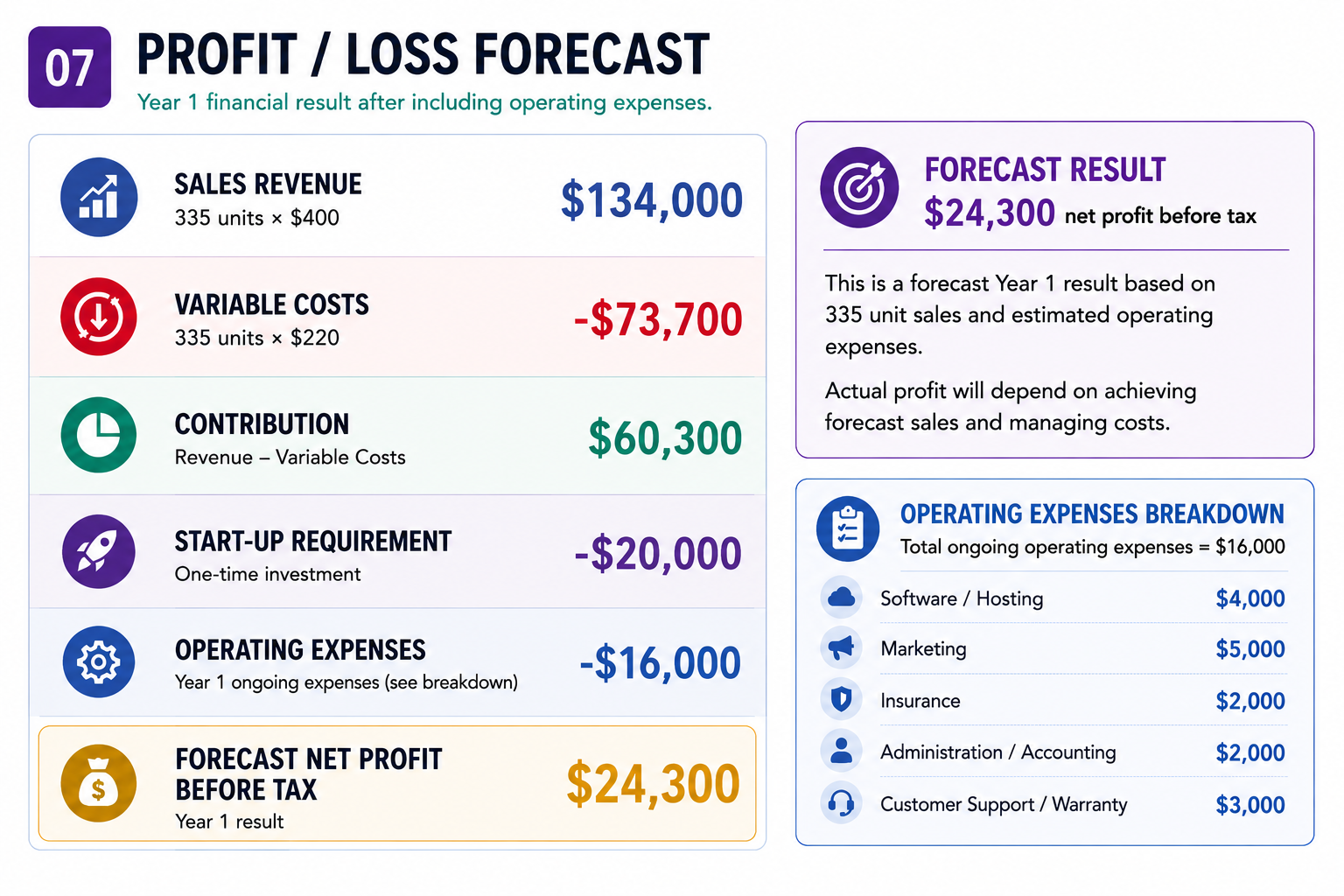
SecureBox Year 1 profit and loss forecast: $134,000 sales revenue, $73,700 variable costs, $60,300 contribution, $20,000 start-up requirement, $16,000 operating expenses and a $24,300 forecast net profit before tax

The 335-unit forecast produces approximately $24,300 profit before tax, but profitability remains dependent on achieving forecast demand and controlling supplier and operating costs.

08Forecast balance sheet

Forecast financial position: end of Year 1

AssetsForecast
Cash (Year 1 closing cash)$44,300
Other business assets / equipment$0
Total assets$44,300
LiabilitiesForecast
External debt$0
Total liabilities$0
EquityForecast
Founder contributed capital$20,000
Forecast current-year profit before tax$24,300
Total equity$44,300
Assets $44,300=Liabilities $0+Equity $44,300

Forecast / prediction only. This simplified Year 1 balance-sheet prediction assumes the $20,000 start-up capital is founder-funded with no external debt. Final asset classifications and values would be updated after actual purchases, depreciation, liabilities and tax obligations are known.

09Financial decision

Do the numbers support launch?

Demand125 paid pre-ordersValidate customer willingness to purchase before larger production runs.
Cost≈ $220 variable costProtect the baseline $180 contribution per unit.
Break-even≈112 units baselineRecovers the $20,000 start-up requirement.
CashPositive liquidityMaintain enough cash to fund inventory and operating commitments.
Recommendation Controlled launch

Financial modelling supports a controlled launch rather than immediate large-scale production. Production should increase only when paid demand, contribution margin and liquidity remain within target levels, reducing the risk of committing capital to unvalidated customer and supplier assumptions.

Section 05

Pitch

The case for SecureBox in short form: the problem, the product, the ask and what happens next.

Watch the pitch

2-Minute SecureBox Pitch

A concise stakeholder pitch outlining SecureBox’s value proposition, purpose, goals and future aspirations.

Watch the 2-Minute Pitch ↗

2-minute stakeholder pitch · supplied with the submission

06References

Evidence behind the plan.

Sources supporting SecureBox’s market, legal, operational and financial analysis. Presented in Harvard style; all sources accessed 3 September 2026.

01

Market & industry

Australia Post (2026) Australia Post eCommerce Report 2026 ↗ Australia Post. Accessed 3 September 2026. Used in: market size / Australian ecommerce
Kwiet-Evans, N. (2025) ‘Porch pirates: More than 4 million Australians have had a parcel go missing’ ↗ Finder, 17 March 2025. Accessed 3 September 2026. Used in: parcel-theft evidence
Australia Post (2026) Parcel Lockers ↗ Australia Post. Accessed 3 September 2026. Used in: competitor analysis
Ring (2026) Video Doorbells ↗ Ring LLC. Accessed 3 September 2026. Used in: competitor analysis / video-doorbell monitoring and alerts
JB Hi-Fi (2026) Store finder ↗ JB Hi-Fi Limited. Accessed 3 September 2026. Used in: proposed retail distribution network / store coverage
02

Business, legal & compliance

ASIC (2026) Register a company ↗ Australian Securities and Investments Commission. Accessed 3 September 2026. Used in: proposed company structure / registration
Australian Government (2026) Choose your business structure ↗ business.gov.au. Accessed 3 September 2026. Used in: business structure evaluation
Australian Business Register (2026) Applying for an ABN ↗ Australian Business Register. Accessed 3 September 2026. Used in: ABN requirements
Australian Taxation Office (2025) Registering for GST ↗ Australian Taxation Office. Accessed 3 September 2026. Used in: GST considerations
ACCC (2026) Consumer rights and guarantees ↗ Australian Competition and Consumer Commission. Accessed 3 September 2026. Used in: Australian Consumer Law
ACCC (2026) Product safety responsibilities ↗ Australian Competition and Consumer Commission. Accessed 3 September 2026. Used in: product safety / testing
03

Intellectual property & digital responsibility

OAIC (2026) Australian Privacy Principles guidelines ↗ Office of the Australian Information Commissioner. Accessed 3 September 2026. Used in: customer data / privacy
OAIC (2025) Data breach response plan ↗ Office of the Australian Information Commissioner. Accessed 3 September 2026. Used in: cybersecurity / data-breach risk
IP Australia (2026) Trade marks ↗ IP Australia. Accessed 3 September 2026. Used in: SecureBox name / brand protection
IP Australia (2026) How to apply for a design right ↗ IP Australia. Accessed 3 September 2026. Used in: SecureBox enclosure / design protection
04

Primary research & internal modelling

Primary research 2026 · n = 36

SecureBox primary market research survey

Unpublished primary research conducted for the SecureBox business plan. No external publication.

Used for 75% parcels left unattended · 80%+ often away during delivery hours · 61% concerned about parcel theft · 78% concept appeal · 81% indicated they would use SecureBox
Internal modelling 2026

SecureBox financial modelling

SecureBox financial projections are internal estimates based on the assumptions stated in the Finance section, not externally sourced or achieved results.

Covers $400 proposed selling price · $220 estimated variable cost · $20,000 estimated start-up requirement · break-even analysis · cash-flow forecast · profit/loss forecast
05

Finance, operations & strategy

Australian Government (2026) Choose a pricing strategy ↗ business.gov.au. Accessed 3 September 2026. Used in: $400 pricing strategy / customer willingness-to-pay / pricing validation
Australian Government (2025) Set up a cash flow statement ↗ business.gov.au. Accessed 3 September 2026. Used in: 12-month cash-flow forecast / projected inflows and outflows / closing cash
Australian Government (2025) Guide to managing cash flow ↗ business.gov.au. Accessed 3 September 2026. Used in: financial risk management / maintaining sufficient cash / changing material costs
Australian Government (2026) Suppliers ↗ business.gov.au. Accessed 3 September 2026. Used in: supplier selection / component sourcing / supplier reliability / multiple-supplier mitigation
Australian Government (2026) Do market research ↗ business.gov.au. Accessed 3 September 2026. Used in: customer validation / survey research / competitor evaluation / pricing validation
06

Risk, cybersecurity & insurance

Australian Signals Directorate (2025) Small business cyber security ↗ Cyber.gov.au. Accessed 3 September 2026. Used in: SecureBox account security / authentication / software updates / customer-data protection
Australian Government (2026) Types of business insurance ↗ business.gov.au. Accessed 3 September 2026. Used in: product liability / public liability / cyber insurance / financial risk management
07

Sustainability & operations

Department of Climate Change, Energy, the Environment and Water (2026) E-Stewardship in Australia ↗ Australian Government. Accessed 3 September 2026. Used in: electronic components / e-waste / replaceable modules / end-of-life management
Department of Climate Change, Energy, the Environment and Water (2025) Product stewardship in Australia ↗ Australian Government. Accessed 3 September 2026. Used in: recyclable packaging / lifecycle responsibility / environmental strategy
Safe Work Australia (n.d.) Manufacturing ↗ Safe Work Australia. Accessed 3 September 2026. Used in: Adelaide assembly / quality control / operational safety
Australian Bureau of Statistics (2025) Retail Trade, Australia: Online retailing ↗ Australian Bureau of Statistics. Accessed 3 September 2026. Used in: Australian online retail demand / continued parcel-delivery demand
08

Product technology & compliance

Australian Communications and Media Authority (2026) 5 steps for suppliers ↗ ACMA. Accessed 3 September 2026. Used in: electronic-product compliance / testing / supplier responsibilities / Australian market entry
Australian Communications and Media Authority (2025) Step 5: label your product ↗ ACMA. Accessed 3 September 2026. Used in: Regulatory Compliance Mark / electronic-component compliance / product labelling
ACCC Product Safety (2026) Lithium-ion batteries guide ↗ Australian Competition and Consumer Commission. Accessed 3 September 2026. Used in: battery safety / electronic-component risk / testing / safe component replacement
09

Camera, surveillance & privacy

Office of the Australian Information Commissioner (2026) Security cameras ↗ OAIC. Accessed 3 September 2026. Used in: SecureBox camera monitoring / recordings / customer privacy / protection of personal information
Government of South Australia (2016) Surveillance Devices Act 2016 (SA) ↗ Government of South Australia. Accessed 3 September 2026. Used in: camera functionality / surveillance-device obligations / responsible video monitoring
10

Strategy, marketing & workforce

Australian Government (2026) Set goals for your business ↗ business.gov.au. Accessed 3 September 2026. Used in: short-term goals / long-term goals / measurable targets / 12-month action plan
Australian Government (2026) Make a risk management plan ↗ business.gov.au. Accessed 3 September 2026. Used in: SecureBox risk matrix / likelihood and consequence / mitigation / risk review
Australian Government (2026) Identify your target market ↗ business.gov.au. Accessed 3 September 2026. Used in: frequent online shoppers / working households / customer segmentation
Australian Government (2026) Develop your marketing plan ↗ business.gov.au. Accessed 3 September 2026. Used in: promotional strategy / marketing channels / launch strategy / performance measurement
Fair Work Ombudsman (2025) Independent contractors ↗ Fair Work Ombudsman. Accessed 3 September 2026. Used in: early contractor-based organisational structure / contractor versus employee responsibilities